Showing posts with label Web Sites. Show all posts

Friday, December 24, 2010

Finding Family on Facebook

Over the past decade, a number of user tools have been developed under the moniker of Web 2.0 applications and some are specifically identified as social media sites. While some of these applications were built on earlier ideas used in the pre-world wide web days, they are easy to use and do not require specific protocols (i.e., gopher, NNTP, FTP, TELNET, and others) to operate. These are web based technologies using hypertext transmission protocol (HTTP) and include but are not limited to the following:

  • photo sharing applications like Flickr and Picasa,
  • journaling tools like Blogger and Blogspot,
  • microblogging functionality with Tumblr and Twitter,
  • document collaboration as found with Google Docs,
  • publishing sites as Knol and Ezine,
  • collaborative information sharing as in Wikipedia and Wikia,
  • video hosting via Vimeo and YouTube,
  • special interest discussion forums like Google Groups and Yahoo Groups, and
  • social networking tools like My Space, Ning, and of course Facebook.

While all of the above can be utilized in relation to your genealogical research, I am going to specifically mention several ways Facebook can aid in your ancestral pursuits. While you won’t specifically find your ancestors per se, Facebook provides the opportunity to network with family members from around the world.

Reconnecting with Close Family

One of the nice things about Facebook is the ability to reconnect with close family members that you have not seen in years. If you are like me, the opportunity of seeing close relatives has been separated by the miles between us. While I typically only converse on the phone with my brothers and my mother, I really have not kept up with nephews, nieces, and cousins on a first hand basis.

Facebook allows you to reconnect with close relatives and friends. For example, I have been posting a number of photos on my Facebook page and sharing these with pertinent relatives. These family members have also shared their old photos with me.

Facebook provides the opportunity to keep in touch without interrupting the personal lives of others. It allows you the ability to transcend time and space and still have a bond with your relatives; albeit, the bond is somewhat of a superficial one. It allows family to be as open with you as much as they are willing and visa versa.

Connections with Lost Family Members

Because of circumstances, there may be close relatives with which you’ve never had contact. In my family this has been the case with the children of my dad’s half sisters. My father was the only child of his father and the sixth and youngest child of his mother. Of his older siblings, only three survived to adulthood.

One sister died prior to my birth and I had the opportunity to know the other two while they were still living. One sister lived about two miles from our home and the other sister lived part of the year in Detroit and the remainder of the year in Florida.

Adding to this was the untimely death of my father when I was almost seven years old. I never had a chance to really know his family. While my Aunt Nath lived across the street from the church that both of our families attended and I spoke with her every Sunday, I really didn't get to know her. My dad's other sister would visit about every other year, but these visits were short, and it wasn't until we started corresponding in the late 1970s that I got to know her better through her letters.

The three sisters had a total of 11 children, Although my Aunt Nath lived near my home, I never met either one of her sons. Both sons have since passed away. When I was eleven years old, I met the three daughters of my dad’s sister Blanche who died in 1945. They were all working in the local hospital and my mother and I were visiting her uncle who had recently had a stroke. She took the time to track down the sisters to introduce them to me.

On two different visits to Detroit, I had the opportunity to meet two of the daughters of my Aunt Ruth. Of the five cousins I have met personally, I only saw two of these more than once, and that was in 1982 when one from each family both visited my mother’s church one Sunday when I happened to be in town. Seven of my cousins I’ve never met and sadly all but one has passed on.

To exacerbate matters, an age difference separated me and these cousins. All of my first cousins on my dad’s side were older than me and some even had children older than me. There really was no contact with this side of the family other than the sporadic letter I would get from my aunt in Detroit.

Facebook has changed this, as I have connected with one of my three surviving first cousins on my dad’s side. In addition, some of his children and the children of his siblings are my Facebook friends. While I do not know much about their families, we have traded photos and opened limited relationships that previously did not exist.

My cousin has also agreed to join in our family Autosomal DNA project. I hope to get my dad’s two surviving nieces to participate as well. His results are pending, but we should share about 6.25% of our DNA as we are half cousins. A full cousin would share approximately 12.5%. He also has the same Mitochondrial DNA as my father and grandmother. So this will be enlightening in regards to our common grandmother's ancient ancestry.

Finding Distant Family

One of the projects I am working on currently is a Y-DNA Surname Project. Because of the extensive cataloging of Roger J. Ouston and the historical research in various archives of Yorkshire by Tim J. Owston, those who share our surname (both spellings Ouston and Owston) have a better understanding of their roots.

The three of us had been researching our respective families and we had connected at about the same time in 1989 and have corresponded since then. By the way, Roger is my ninth cousin and Tim is my seventh cousin once removed.

In our combined research, we discovered that there were three unique families that shared our unusual surname; however, there were no surviving records that connected any of the three groups. For simplicity sake, I have named these groups as Owston A, Owston B, and Owston C. They were alphabetized according to their most distant known ancestor.

OWSTON A – Ganton/Foxholes

Owston A can be traced back to John Owston who was living in 1490. This family settled in and around Ganton and Foxholes in the former East Riding of Yorkshire. This area is now in the newer county of North Yorkshire.

Although this is the oldest group, all of its descendants come from one couple: Thomas Owston (1753-1823) and Mary Vickerman (1753-1818). It constitutes the largest group of Owstons in the United States. While there are numerous Owston A descendants in the US, currently those with the surname are descended from two of Thomas’ and Mary’s sons: Thomas and Francis.

OWSTON B – Sherburn

The families from Owston B (which contains the Ouston clans) are descended from Peter Owston who died in 1567. This family settled in Sherburn and West Heslerton in the former East Riding of Yorkshire. These hamlets, along with Ganton and Foxholes, are now located within the Ryedale district of North Yorkshire. Sherburn is two miles west of Ganton.

Owston B is most diverse line of Owstons and consequently it is the largest worldwide. While the most distant relationship among Owston A families is at the 6th cousin level, Owston B relatives can be as distant as 10th cousins.

Due to non paternal events, a very large number of individuals from this lineage are descended from an illegitimate son who had taken his mother’s surname. Although still related to other Sherburn Owstons, this group will not share the same paternal Y-DNA as do other Sherburn Owstons. There is also a sizable contingency of Oustons in the United Kingdom, New Zealand, Canada, and Australia and a family of Owstons in Western Australia that are all connected to Owston B.

Three lines currently exist in North America: a family of Oustons descended from Robert Schipper Ouston in Canada, a family descended from John Beilby Owston who had settled in Detroit, and the progeny of Royal Navy warrant officer William Owston – the line from which I descend.

OWSTON C – Thornholme/Burton Agnes

This line developed south of the other two lines, but within 15 miles of Ganton and Sherburn. The hamlet of Thornholme and its parish of Burton Agnes are located in both the historic region and the current county named as the East Riding of Yorkshire.

The Owston C family is descended from Richard Owston who was living at about 1700. This is the smallest group of Owstons worldwide and at one time was the largest group of Owstons in Canada. This may no longer be the case as there appears to be more individuals named Ouston from the Sherburn line than Owstons from the Thornholme line currently living in Canada.

There have been several Owston C families in the US; however, the last individual bearing the surname from this line died about 20 years ago. Another line where the surname doesn't continue is of that of naturalist Alan Owston.

Married twice to Japanese women, Alan Owston's daughter from his first marriage was raised in Maine and the children of his second marriage settled in British Columbia following his death in Japan. These descendants, who were half Japanese, were also from the Thornholme line. Unfortunately, only non-Owston descendants survive from this family and the appellation Owston can be found used as a middle name among the survivors.

There is another Owston C family which had taken the hyphenated Owston-Doyle surname in the early twentieth century in England. Descendants bearing this hyphenated surname live in New Zealand.

The widest relationship among members of the Owston C line is at the eighth cousin level.

Tracking a Surname

Having an unusual surname makes it easier to find folks that have a potential relationship. According to the 2000 census, the Owston surname is ranked as the 118,236th most popular name in the US – with 136 individuals bearing the surname. In addition, 93.38% of those named Owston are listed as non-Hispanic whites; however, the racial and ethnic mix of the other 6.62% of those remaining is hidden with the exception of the category of non-Hispanic Asian and Pacific Islander, which is listed as 0%.

The Census Bureau has suppressed data percentages for minority races and ethnicities when the numbers fall below a certain threshold. In the case of the Owston surname, information is not available for the following groups: non-Hispanic black, non-Hispanic American Indian and Alaskan native, non-Hispanic two or more races, and those of Hispanic origin. Since 0% is not listed as with Asians and Pacific Islanders, one may assume that the other categories are represented, however, in small numbers.

Additionally, the ranking of 118,236th for the surname is down from the previous census which garnered a ranking as the 61,384th most popular surname in the US. While the Census Bureau does not provide corresponding headcounts for 1990, there is an appearance that the number of individuals with our surname drastically decreased over the ten year period. Figures from the 2010 census are not yet available.

While the specifics are not known, it may be supposed that the drop in numbers can be attributed to several factors including, but not limited to, the following: a larger ratio of deaths in comparison to births, a larger percent of females marrying and taking their husbands’ surnames, and a larger number of divorces where the ex-wife reverted to her maiden name rather than keep her ex-husband’s name.

While over the years the surname Ouston has been in use in the United States, the numbers have never been in large in comparison to the Owston spelling. In regards to the spelling today, either a very small number of persons or none at all are currently living in the US under this alternative spelling.

In the United Kingdom, the Owston spelling, with 154 individuals, ranks at the 19,127th most popular surname. In Australia, only 16 individuals share the name and it is ranked as the 61,822nd most popular name. The Ouston variation represents a smaller percentage of the populace and does not appear in the UK database. Numbers were not available for either Canada or New Zealand where Owstons and Oustons both dwell.

Interestingly enough, there are three pronunciations of the name.  The majority of Owstons/Oustons worldwide pronounce the surname as OW-ston.  A large contingency of American Owstons from the Ganton line pronounce it as OH-ston.  Finally, a small Thornholme family in Canada call themselves by the name of OO-ston. 

It is probably safe to assume that less than 500 individuals worldwide bear the surnames of Owston and Ouston. While there is an appearance that some who are named Ouston may have different origins than East Yorkshire, the bulk of Owstons and Oustons probably trace back to one of the aforementioned families.

Those who have a more common surname will have great difficulty in repeating this exercise as the sources of these names may be radically different. In some cases a common name such as Smith may be descended from anyone whose ancestors were blacksmiths, tinsmiths, silversmiths, coppersmiths, and etc. Family origins were probably from a very wide geographic area.

It may be a case where the surname was Anglicized to Smith from a name meaning the same occupation in other languages as in Schmidt (German), Smits (Dutch), Kowalski (Polish), Herrera (Spanish), Ferraro (Italian), Kovacs (Hungarian), or Haddad (Arabian).

It also was a name that many adopted as a surname over the years for a variety of reasons - to become Americanized or taking a former slave owner's surname. Trying to connect various Smith families would be impossible as no connection is likely to exist. Therefore, common names have severe limitations in trying to do a wide surname search.

My first exercise in tracking my surname in the US and Canada came by doing directory assistance searches of the major cities in every area code in 1978. At this time, directory assistance was a free service through AT&T. I was able to contact a number of folks this way and it helped in either connecting to or distancing our line from other various Owston families as no connection seemed imminent. At the time, I was unaware of the Ouston spelling variation.

Using Facebook to Connect

I was one of the first with our surname to join Facebook when it was primarily a site used for students and educators. When it became available to anyone, the social networking site’s floodgates opened and hoards of individuals streamed in as users.

Immediately, others with the Owston surname were asking to be friends. I sought out a few myself and there is a small network of Owstons who only know each other through Facebook and are connected to one another by electrons and possibly by blood.

In preparation of doing a Y-DNA surname study, I began searching the surnames of Owston and Ouston on Facebook and tried to determine each individual's family of origin if possible. Since several people had more than one Facebook page, I counted these individuals only once.

The list includes those born as Owstons/Oustons, women who listed their Ouston/Owston maiden name as an alternative to their married name, those who currently wear the surname due to marriage or adoption, divorced women still using the surname, those with hyphenated names, and the occasional individual with a first or middle name of Ouston or Owston.

Individuals with the surname were found in the the UK (England, Scotland, and Wales), the US, Australia, Canada, New Zealand, Nigeria, and the Philippines.

The numbers are as follows:

Owston238
Ouston120
Owston-Doyle7
Owston-Dale1
Owston-Duncalf1
Owston-Morrell1
Pacheo-Owston1
Reid-Owston1
Stockill-Owston1
Owston as a first name1
Owston as a middle name1
Ouston as a middle name1

By comparing the names (and the names of the individual’s friends) and locations to Roger Ouston’s directory of Ouston and Owston families, I was able to ascertain the family group for nearly two-thirds of the individuals with the surname. The numbers are as follows:

Definitely Owston A4311.50%
Likely Owston A61.60%
Definitely Owston B12633.69%
Likely Owston B4612.30%
Definitely Owston C184.81%
Unknown13536.10%

Those listed as likely being part of the Owston A and Owston B lines are ascertained by their locations and/or who their friends are; however, I am unable to determine their exact relationship within their specific line. The large number of unknown individuals are those whose locations and friend information is not viewable by non-friends. Some of these accounts may be abandoned or duplicate accounts.

Removing the unknowns and combining the numbers of definite and likely members, the percentages of family members with the Owston/Ouston surname are probably close to the actual worldwide percentages.

Owston A4920.50%
Owston B17271.97%
Owston C187.53%

For those who are related to me in the Sherburn or Owston B group, I am able to trace the degree of relationship I have with these individuals. These numbers only include those who have the Owston or Ouston name associated with their profile – those who do not are not represented in these numbers.

Self/Siblings2
Nephews/Nieces5
Second Cousins2
Second Cousins Once Removed2
Third Cousins1
Third Cousins Once Removed2
Fourth Cousins1
Fourth Cousins Once Removed3
Fourth Cousins Twice Removed2
Seventh Cousins Once Removed3
Seventh Cousins Twice Removed4
Eighth Cousins8
Eighth Cousins Once Removed14
Eighth Cousins Twice Removed3
Eighth Cousins Thrice Removed2
Ninth Cousins10
Ninth Cousins Once Removed19
Ninth Cousins Twice Removed4
Tenth Cousins Once Removed5
Tenth Cousins Twice Removed9
Tenth Cousins Thrice Removed4
Wives, Ex-Wives, and Widows of Relatives19
Step Children of Relatives2
Likely Seventh Cousins5
Likely Ninth Cousins35
Likely Tenth Cousins6

If you notice, there are no first cousins (as my father was his father’s only child) and there are gaps at the fifth and sixth cousin levels. No Owston descendants have continued to the present from the siblings of my third and fourth great grandfathers.

While it took a while to analyze these 374 accounts, I found it an interesting exercise in trying to learn more about those who happen to share my unique surname.

Building A Community

One of the ways to connect on Facebook is to create a community page. When I first publicized this post, I heard from Sonia L. on DNA Forums. She provided a suggestion of setting up a community page on Facebook.

I have completed this task and the page can be found at http://www.facebook.com/pages/Owston-Ouston-Families/179582775398948. Anyone with a connection to these families is free to join and participate. Hopefully, we can learn more about our surname and families.

Connecting the Three Families

While no documentation serves to connect the Owston A, Owston B, and Owston C families, certain circumstantial documentation indicates a possible connection. One circumstantial piece of evidence comes from the will of John Owston, son of Peter Owston - the progenitor of the Owston B line.

Within this document from 1615, the testator, John Owston (Owston B), forgave the debt of five shillings owed by Robert Owston of Potter Brompton (Owston A). Unfortunately this document does not indicate a relationship between Robert and John - only that John had lent money to Robert. While this apparent lender/lessee relationship existed, a family connection may not have existed.

Additionally, Roger Ouston theorized that a connection existed between the Ganton (Owston A) and Thornholme (Owston C) lines based on onomastic evidence of the similarity of early forenames found exclusively in both lines (but not in Owston B).

While considered a weaker form of evidence in connecting families, it is often the only piece of evidence that is available and genealogists have grown to accept its value in certain situations. Although Roger's argument was well constructed, it could not be considered conclusive in proving an absolute relationship.

Even with the short distance of their origins and the existence of other evidence suggesting a relationship among the three lines, nothing conclusively proves a familial connection among Owston A, Owston B, & Owston C lines. With the lack of documentation proving a relationship, only Y-DNA testing could prove that the families share ancestral ties along the paternal or surname line.

Through connections I have made on Facebook, I have asked members of the three lines to participate in Y-DNA testing. Currently, I have two from every line except the Owston C group. At present, only one individual from Owston C has committed to the project. I am looking for another from this lineage that is not a close relative to my first participant.

By comparing the results, it is possible to determine if all three or two of the three families share a common male ancestor. I am hoping that the results will show we have common roots; however, I will not know until all of the lab work is completed. Having been tested at the Y-DNA 46 and 67 marker level, my haplogroup falls within a Norse haplogroup that is variously identified as I1, I1*, and I1-M253.

Results of the Y-DNA tests should be available by January or February 2011. While there are several Owstons that have had a broken male descent and some with multiple illegitimacies, I have been careful in asking those who do not have non paternal events within their surname lineage. It will be interesting to see the results.

For more information on the Owston/Ouston Y-DNA Project, see https://www.familytreedna.com/group-join.aspx?Group=Owston or contact me directly.

While Facebook was not designed as a genealogical tool, it can become a means to an end. It allows you to reconnect with close family members. You can initialize contact with family members that have become distant because of circumstances. It is also interesting to see how much commonality you share with those who share an ancestral bond. Finally, it can aid in surname studies if your name is unique enough to easily track.


Sources

British Surnames and Surname Data: Surname Summary Data for Owston. http://www.britishsurnames.co.uk/surnames/OWSTON

Genealogy Data: Frequently Occurring Surnames from Census 1990. Washington, DC: US Census Bureau, 1996. http://www.census.gov/genealogy/www/data/1990surnames/index.html

Genealogy Data: Frequently Occurring Surnames from Census 2000. Washington, DC: US Census Bureau, 2009. http://www.census.gov/genealogy/www/freqnames2k.html

Ouston, R.J. A Directory of Ouston and Owston Families. Roger J. Ouston, 2003.

Owston, T.J. Owston Family: Sherburn Based Branch of the Family, East Yorkshire with Links to Other Branches. York: Timothy J. Owston, 2010. http://freespace.virgin.net/owston.tj/owstonln.htm

Saturday, October 30, 2010

Genealogy by Google Books

In the last several weeks, two individuals posted on a couple of genetic genealogy sites extolling the virtues of Google Books as a research tool. It’s ironic that I have been also considering writing on this topic concerning how I have been using this specific Google search tool to aid in my family research.


I started using Google Books several years ago while doing a literature review for my doctoral dissertation. I found it an excellent source for information from published materials; some of the books, journals, and magazines featured on Google Books have been out of print for decades. Others are even over a century old. While there are other sites with old books and magazines, Google Books is by far the best.

Types of Items Available

Google has partnered with libraries and publishers to allow some material to be available online through Google Books. All types of published material is available that runs the gamut from fiction to non-fiction, from textbooks to technical manuals, and from historical magazines to limited self-published genealogies.

The available materials are within the public domain as well as those currently under copyright. Based on the specific arrangement with the copyright holder, archive, or library, some books may have full view, limited preview, snippet view, or no preview. I’ll address each of these views.

Full View

Generally for materials in the public domain, full view documents are available completely online. These books/magazines can be saved as complete PDF files or pages can be converted to text so that pertinent information may be copied and pasted into family history programs or word processed documents. These items are either in the public domain or out-of-print with permission of the copyright holder.

In the US, anything published or registered for copyright prior to 1923 is currently in the public domain. Later copyrighted or published materials may be in the public domain if the copyright holder failed to renew the copyright on or before its renewal date. Depending on when a item was copyrighted or published and when the death of the author occurred, different dates apply when a work enters the public domain.

Limited View

The limited view is found for materials that are currently under copyright. Some, but not all, of the book is available for reading. In some cases entire chapters may be intact; however, usually key sections are unavailable. Search results return both available and unavailable pages. The book cannot be saved as a PDF nor can it be converted to plain text; however, print screen allows you to save pages as images.

Snippet View

While documents in snippet view are frustrating, these still can yield important information for your genealogical search. Some volumes now in snippet view may eventually become full view, I have found one that actually regressed to a no preview status. I’ll discuss how to get around the limitations of snippet view later in this article.

No Preview

Probably the most frustrating of the returns are those published materials that are not available for view. While you will not be able to read any of the information concerning the search return, Google Books returns the number of times the search criteria was found in the volume. Complete publication information is also provided so that you may be able to find the book for sale or at a local library.

Examples of Genealogical Data I've Only Found on Google Books

During the same period as I was conducting my doctoral research, I started also using Google Books to discover aspects of my own family. I had some surprising results. These included the following bits of information:
  1. My great-great grandfather’s (John Gillon Owston) exact date of birth, his photo, and a brief history of his career as a rail road engineer. This sketch documented a period in his life in Saginaw, Michigan that was heretofore unknown (1863-1868).

    Because of this, I was able to further discover that he had a wife of which I had not known – a woman he married and that he apparently divorced by 1873. While the information of the second of his three wives was not found in Google Books, the knowledge gained from his biographical sketch in the Brotherhood of Locomotive Engineers Monthly Journal provided a springboard for additional information on this key ancestor. 

    Since writing this piece, I also found a description of this same ancestor's surprise seventieth birthday party. It was found in a January 1897 edition of The Brotherhood of Locomotive Engineers Monthly Journal.

  2. One of my great-grandfather’s first cousins’ literary pursuits. For about 14 years, I have known that Euphemia Frances Smith (under the pen name of Frances M. Owston Smith) had a number of poems that were published in Canada and the US. Over the years, I had not been able to find any of her published works; however, these and her biography were eventually scanned and uploaded to Google Books.

    Her biography, which I had procured a number of years ago, was also accompanied by her photo in American Women: Fifteen Hundred Biographies with over 1,400 Portraits. In addition, her photograph, signature, and a half dozen poems were featured in The Magazine of Poetry: A Quarterly Review, Volume 5.
  3. An 1867 published short by another first cousin of my great-grandfather. “Elsie Frasier’s Work,” printed in Hours at Home, may have been based upon the experiences of actual family members named Frasier. The story is replete with examples of the vernacular of Edinburgh, Scotland.  

    In addition, Frances W. Owston also had a prize winning literary work that was published in the New York Observer in 1865. This information is referenced on Google Books; however, it is not currently available online. I had no prior knowledge of this short story entitled “The Brothers Leinhardt.” Perhaps someday it will also become part of the catalog of Google Books.
  4. Google Books includes a published story of another one of my great-grandfather’s first cousins “Rose Elliot,” Jane Gillon Owston’s example of prose drew upon the experiences she had from living in Edinburgh in the 1850s and 60s. It provides a look at life in a 19th century Scottish fishing village. The author was careful to provide glimpses of Scots English throughout the piece. This was found in an 1878 issue of Frank Leslie’s Sunday Magazine.
  5. A complete listing of my great-great grandfather’s first cousin’s family with birth, marriage, and death dates. This documentation was discovered in The Scottish Law Reporter’s analysis of the contest of John Gillon's will.
  6. The ancestry of my great grandmother’s family that chronicles several generations with key dates in The History of Montville, Connecticut – formerly the North Parish of New London from 1640 to 1896.
  7. Three Gardner lines on my father’s side that converge into one that can be traced back to King Edward III of England. This was found in Gardiner-Gardner genealogy: including the English ancestry of George Gardiner, immigrant ancestor of Newport, R.I., & many of his descendants, especially his grandson, Stephen Gardiner of Gardner Lake, Connecticut.

    While a snippet view is only available on Google Books, I found the complete volume on Ancestry.com and was able to access our royal lineage.  Ancestry's search of the family did not allow for a narrowing of the search that would have revealed this information. Therefore, without Google Books, I would have overlooked this extremely important volume.
  8. The names of my step-father’s three half siblings that did not survive infancy. One lived to be four months old, while the other two only lived several hours each. Even cemetery records did not have names listed for these three children - they were only recorded as "Infant Akerberg."

    This information was found in a published family history that was written by my step-father’s step-mother’s uncle (got that?). Portions of this book were available last year on Google Books in short snippets of text, but since that time, textual access to the book was restricted to no preview.
  9. Although too numerous to specifically mention, most of my colonial lines are well documented in volumes found on Google Books. Anyone searching colonial families should have tremendous luck using this tool.

Maximize Your Searches in Google Books

There are certain tricks on how to maximize your searches in Google Books; these same techniques will work on all of Google.

Search names as exact phrases

When searching for specific names, do so by exact phrases. For example, search for a name encased in quotation marks. For example, in searching for my great-great grandfather Isaac S. Champlin, I can do it by word or phrase. If I search by word as Isaac S. Champlin, Google Books returns nearly 16,000 hits. If I search by phrase as “Isaac S. Champlin,” Google Books provides only one return – the only pertinent volume relating to my search.

Search names in reverse order

You may find alternate listings for a person you are searching by searching in reverse order. If I were to search for “Martin Brechall,” I would see a return of 149 references. By searching in reverse order for “Brechall, Martin,” I may find additional references in the 72 that are returned. One danger in this is a false positive which may return a page that is actually a listing for two different people such as “Reuben Brechall, Martin Swiger.”

Search multiple words or phrases with Google operatives

Google provides a number of operatives that aid in narrowing your search.

The Plus Sign + is the AND/MUST operative is used when you want to insure that all of the search terms or phrases are used in the search. The plus sign must be next to the search term or phrase without a space on its right side.

To search for my ancestor Thomas French, I may want to make sure that the only Thomas French returned is the correct one. I can do this by formulating the search with the AND/MUST operatives as: +"Thomas French" +Burlington +"New Jersey."

Sometimes using the AND/MUST operative returns the same number as not using the operatives. This is really dependent upon the available materials. The larger number of possible entries will produces a larger variance between the two search methods.

If I search for my surname in relation to Pittsburgh (our family's home since 1838), I get 412 returns for a search of Owston Pittsburgh; however, this is narrowed to 405 when searching +Owston +Pittsburgh.

The Minus Sign - is the NOT/ELIMINATE operative and is used when you want to omit certain pages that contain a word or phrase. The minus sign must be next to the search term or phrase without a space on its right side.

If I want to search for my 3rd great-grandfather, I could just search his name. William Owston brings 12,100 hits.  “William Owston” narrows the search to 241.

Since William Owston appears on a number Royal Navy lists, I can eliminate the word navy in my search as “William Owston” –Navy. This equals 175 returns.

The Tilde ~ is the SYNONYM operative. Using the tilde (up next to the word) will allow synonyms to be searched. This operative does not appear to work with phrases. Although this is an option, I find it less important than the AND/MUST and the NOT/ELIMINATE operatives.

Search misspellings

If the surname you are researching can be spelled numerous ways, try searching an alternate spelling. With my surname of Owston frequently having been misspelled, I have found a number of references that I would have missed had I not searched for Owsten, Ouston, and Ousten. Several important links to my past were only discovered by doing a misspelling search.

Search names by initials

In the 19th and early 20th century, men were often identified in print by their first and middle initials and surname. Encase the name within quotation marks such as I did with “C.W. Owston.” My great grandfather’s first cousin, Charles William Owston, was an executive with Standard Oil during the monopoly’s heyday. Several volumes reference him as C.W. Owston and give a clearer picture of his employment history. Searching his full or partial name does not return most of these references.

Disable Spelling Autocorrect

Occasionally, Google’s algorithm will attempt to out think your searches by respelling words to what it believes is proper. This can happen with names or even with certain words. For example, I used the British version of the word gaol which is pronounced the same as its American counterpart – jail. During this search, Google Books rethought my spelling and corrected the search to be goal. This can be disabled by placing the word or name within quotation marks and Google Books will not autocorrect your spelling.

Getting Full Text Results from Snippet View

As mentioned previously, snippet view books and articles can be frustrating. While you may not be able to gain the entire text, you should be able to return enough to satisfy your needs. In relation to the above, I searched Google Books for my last name of Owston and “gaol” to see if there were any examples of individuals bearing my surname being recorded as a prisoner.

With my search, I found a snippet view book with information concerning an Ann Owston who was sentenced to death. With snippet view books, you may receive a portion in the description and a different portion with the partial page return.

Step 1: In the search summary, we learn the following:

“OWSTON, ANN (c1754-1811) Ann Owston was sentenced to death at the 9 August 1787 Croydon (Surrey) Assizes for the ...”

Step 2: When we look at the page snippet, we gain the following information; however, there is no continuity with the previous search summary.


“April 1807. The couple appear to have separated, however, and Owston returned to Sydney some time during the years 1797-1801. In 1806, she was reported as childless and a resident of New South Wales. She was living alone in a house in the Hawkesbury district [probably at Windsor] when she signed a . . . ”

Step 3: We then take a portion of the text in the Step 1 and search within the volume. This portion is "Croydon (Surrey) Assizes for the."

We receive a completed paragraph with the additional information of “August 1787 Croydon (Surrey). Assizes for the theft of eight yards of muslin from a shop in St. Georges parish, Southwark. She was reprieved soon afterwards to seven years transportation and was held in gaol until about April 1789, when she embarked upon the Lady Juliana, transport, age given as 33.”

Step 4: We return to the main search page and enter the following “Lady Juliana, transport, age given as 33.” No additional information was returned.

Step 5: Since we are at a standstill, a search for the page number of 466 provides a key to other names on this page.

One of the names is Edward Page. A search on this name would prove fruitful by providing additional information on our subject Ann Owston. In this process, we gained the following knowledge:


“Eight weeks after landing at Sydney Cove Owston was among 194 mostly female convicts sent to Norfolk Island, arriving 7 August 1790. In July 1791 Owston was issued with a pig under Major Ross’s plan to encourage convicts to become self-sufficient. The First Fleet convict William Blunt . . .”

Step 6: With searches on “convict William Blunt” not providing anything additional to the mix, a look at the second column on the page provides key language of “SE of Faversham.” This phrase was searched on the main Google Books’ search tool.


Step 7: While the link inside the book did not provide any additional information, the description in the search return added "21 October 1786 of a silver watch."

Step 8: Inside the book, "21 October 1786 of a silver watch" was searched which returned additional information from the opposite column that read: “(b. c. 1756, tried Old Bailey) received a pig on the same day. Her position on the list after his name indicates that their association dates about this time. In July Blunt was recorded supporting one other person on a one acre allotment at Sydney Town, the island’s main settlement. They were prob-“


Step 9: The phrase “allotment at Sydney Town, the island’s main settlement” was searched via the main Google Books’ search engine and provided the additional verbiage “allotment at Sydney Town, the island's main settlement. They were probably still subjected to convict discipline and required to devote part of their time to . . .”

Step 10: Using the main search tool, “convict discipline and required to devote part of their time to” was searched and returned the additional information: “government tasks; but most convicts in this position were allowed a shorter working week to enable them to attend to their land . . .”

Since a search of “enable them to attend to their land” returned nothing additional, the beginning of the next section with “Blunt was recorded as a constable in 1805 and died on the island.” This linked it to the phrase “in April 1807.”


While I am not going to carry out the entire process here, I believe you can see by alternating between the main Google Books’ search engine, and a search within the volume, it is possible to recreate a complete section from a book that only has a Snippet View in Google Books.

The following is the entire piece that took about twenty minutes to recreate from various snippets and page descriptions using Google Books:

OWSTON, ANN (c1754-1811) Ann Owston was sentenced to death at the 9 August 1787 Croydon (Surrey). Assizes for the theft of eight yards of muslin from a shop in St. Georges parish, Southwark. She was reprieved soon afterwards to seven years transportation and was held in gaol until about April 1789, when she embarked upon the Lady Juliana, transport, age given as 33.
Eight weeks after landing at Sydney Cove Owston was among 194 mostly female convicts sent to Norfolk Island, arriving 7 August 1790. In July 1791 Owston was issued with a pig under Major Ross’s plan to encourage convicts to become self-sufficient. The First Fleet convict William Blunt (b. c. 1756, tried Old Bailey) received a pig on the same day. Her position on the list after his name indicates that their association dates about this time. In July Blunt was recorded supporting one other person on a one acre allotment at Sydney Town, the island’s main settlement. They were probably still subjected to convict discipline and required to devote part of their time to government tasks; but most convicts in this position were allowed a shorter working week to enable them to attend to their land. By the end of the year the couple had moved to a 12 acre farm at Grenville Vale (lot no.20). Her son James (1794) appears to have died in infancy.
In June 1794 they were described as a childless married couple; they had probably been among the many couples married by the Rev. Richard Johnson when he briefly visited the island in November 1791 with no record of the individual ceremonies surviving, Blunt was recorded as a constable in 1805 and died on the island in April 1807. The couple appear to have separated, however, and Owston returned to Sydney some time during the years 1797-1801.
In 1806, she was reported as childless and a resident of New South Wales. She was living alone in a house in the Hawkesbury district [probably at Windsor] when she signed a deposition with a mark X on 15 May 1810 stating that she had been raped by Lawrence Finland at her home. He was acquitted when she failed to appear at his trial at the Sydney Court of Criminal Jurisdiction. Her burial on 17 September 1811 was recorded in the register of St. Phillips, Sydney. She was described as from London [meaning she was believed to have been born there], aged 65 [she was nearer 55 according to the age given on embarkation and had borne a child only 17 years before].
Notes: her name was rendered Owton on the 1810 deposition (AONSW CCJ 1810); see also SG 2 June 1810.

The above came from Michael Flynn's The Second Fleet: Britain's grim convict armada of 1790, 1993, Sydney, Australia: The Library of Australian History, p. 466. 

Google Books is replete with examples of snippet view books that with a little effort may provide keys to important genealogical information found nowhere else.

Epilogue

Google Books is powerful tool for all types of research including genealogical research. Several loopholes were closed by the material I’ve found on this specialized search tool. Try searching your family and see what you can find.

Thursday, September 30, 2010

Communing with the Dead

Recently on the crime drama “Bones,” Emily Deschanel who portrays Dr. Temperance Brennan so aptly stated, "My most meaningful relationships are with dead people." As genealogists, we are often dealing more with the dead than we are with the living.

There are times in our genealogical pursuits that we wish that we could conjure up our ancestors from the beyond so that they may enlighten us about our families. While some believe they can actually do this, I personally do not desire to cross that chasm between the living and the dead until it is my time to go; however, I believe that the dead speak yet.


As a child, I guess I became accustomed to the serenity of rolling hills of green that were dotted with granite, marble, and bronze. This came early. At age seven, I began accompanying my mother on her visits to the graves of my father and grandparents so she might tend to the flowers she had planted as as a memorial. As I began searching my own family history, I frequently found myself haunting graveyards looking for long lost relatives.

When I began researching a Civil War unit, I was drawn to numerous cemeteries searching for the final resting places of these soldiers of the rebellion. My kids can attest that when they were younger, I dragged them around from town to town looking for these elusive graves and recording their epitaphs on film.

Now let's shake that Magic 8-Ball.

Several years ago, I stumbled upon an interesting web site that allowed individuals to create memorials for loved ones or any other deceased individual. FindAGrave.com has been online since 1995 and was the brainchild of Jim Tipton who created the site that now has nearly four million visits daily.
In the infancy of the public’s embrace of the Internet, Tipton could not find any site on the web that dealt with his hobby of visiting graveyards – something that he too has been doing since childhood. Therefore, he created Find A Grave.

I do not remember when I first discovered Find A Grave, but it was probably between 1998 and 2000. No doubt, I found it by searching the Internet for people bearing my own surname. For years, I considered contributing to the site with my own relatives, but did not officially join until October 2008. My decision to do so was prompted by taking photos of my great-great grandparents’ graves at Grandview Cemetery in Johnstown, PA. My mother and youngest daughter accompanied me on the trip.

It was a few days after my mother’s 90th birthday and she had never visited the graves of her grandfather’s parents. Her grandfather’s three sisters were also buried there and she had met them as a child and had stayed overnight with her grandfather’s youngest sister. The same day, I also was able to photograph the graves of several Civil War veterans from the 9th Pennsylvania Reserves I had been researching.

 Monument for the Unknown Dead from the Johnstown Flood at Grandview

That same week, I visited another Grandview Cemetery – this time in my hometown of North Versailles, Pennsylvania and re-photographed the graves of my father, grandfather, grandmother, aunt, and uncle. On October 11, 2008, these five graves became my first entries on Find A Grave.

Nine days later, I uploaded memorials for numerous other family and Civil War Veterans. Included among this list were the first graves I visited for genealogical purposes – my second great grandparents John Merriman and his wife, Sarah Ann Jones Merriman.

I first visited these graves in 1968 after being inspired by an 8th grade English class assignment that required the students to write a brief family history and create a family tree. I’m indebted to Mr. George Ihnat for introducing me to a lifelong hobby.

In the process of doing my research, my mother found a yellowed newspaper clipping that recounted the death of Sarah Merriman who was the oldest living woman in McKeesport. It mentioned her burial location and my mother and I drove to the cemetery and after checking into the office, we were able to find her and her husband’s grave.

While these were the only two marked graves on this site, I found out later that nearly a dozen other graves were in this plot – most were children. I was happy to finally document these unmarked burial sites on Find A Grave.

While my original intent was to upload only family graves on the site, I noticed that this fairly large cemetery with over 40,000 graves had only a representation of 150 on Find A Grave. In late 2008, I took my copy of the interment records and began preparing these for inclusion on Find A Grave. By summer, all of the graves up through 2006 were documented.

Knowing that many people are searching for ancestors, but do not know where they are buried, I felt that by adding to the massive number of (over 51 million) grave records already on Find A Grave that I could help others find their family members. 

In the process, I would be able to memorialize my own relatives. These included 146 out of 215 individuals with my surname and 73 out 104 memorials with my mother’s maiden name. Other individuals find it their duty to photograph grave markers that people request.

In the process I hear from a number of folk that were able to track down grave locations of close and distant relatives. For example, this week I received a request from a gentleman in England who was searching for his great-great grandfather that had for a brief time lived in McKeesport, Pennsylvania.

He had found a name that I had added over a year ago to the FindAGrave.com database. The memorial was found among the over 40,000 I had uploaded for the McKeesport-Versailles Cemetery and I told him that all I knew about this individual was already online.

According to his research, the family had emigrated to the US in the early 1880s, lived in McKeesport, and returned to England to appear in the 1891 census; albeit, the great-great grandfather was absent and no further information was available concerning what happened to him. Having experienced similar brick walls in my research, I could empathize with his plight.

I also was impressed with his willingness to find concrete evidence before claiming this gentleman as his deceased ancestor. I did not hold out much hope for him securing the proper evidence as Pennsylvania vital records prior to 1906 are scant at best when the event occurred outside a major city.

Although the cemetery usually does not take email requests for family data, they did provide him the age of death of this man as being 38. This agreed with what he knew about the mystery man and I was able to provide him information on how to secure a death record for the municipality. These began to be recorded just two months prior to his supposed ancestor’s death.

As I cautioned, there is no guarantee that a record existed as they were not mandatory until statewide adoption in 1906. I’ve been down this route as a number of my ancestors who were born or died in McKeesport prior to 1906 did not have corresponding records for the event. In addition, I provided him the link to the local historical center which could provide him a copy of the death notice in the local paper if one exists. Since there are no other extant records for him locally, I am anxious to see the results.

By searching Find A Grave, I have found the resting place of a number of deceased family members and friends.  By having my own family on Find A Grave, I have met distant relatives that allowed me to learn more about my own ancestry.
Since I began posting on the site, I have been contacted by a first cousin, thrice removed who is also my second cousin, twice removed who was researching his father’s roots. I knew about his father who is moderately famous, but never had any contact with him.

A third cousin, once removed was a source for additional information on our common ancestors on my mother's side of the family. He found my memorial for my great-grandfather who led him to contact me. While he had a wealth of information, I had specific info that he did not have. He used this and was able to take our family back six additional generations through researching parish records at an LDS Family History Center near his home.

Early this year, a half-first cousin, twice removed contacted me after seeing memorials in reference to some of our shared family members. Being considerably younger than his grandmother who is my half-first cousin, I really didn’t know her. I met her once when I was twelve years old and met her daughter once when I was 20. While I didn’t gain any great genealogical knowledge from my email and phone conversations with my newly found cousin, I was able to reconnect with a part of my family I barely knew.

Find A Grave also helped me connect with individuals connected with the Civil War vets I’ve been researching. One of my photos from Johnstown, PA provided me a contact with the soldier’s great-great granddaughter. I was able to supply a great deal of information regarding her ancestor and she provided me a scan of his tintype photo. It was a win-win situation.


It also has been a place where folks from my past have been able to reconnect. A distant cousin with whom I was in contact with in 1996 found me on Find A Grave and reconnected with me. A few days ago, I received my invitation to a family reunion next year – the last one was ten years ago.

Last week, a college friend who is now a funeral director found my listing on the site and we reconnected after 31 years of silence. We were classmates, coworkers, and even next door neighbors for a while. We were able to find each other because of Find A Grave.

Grant it (or jokingly granite), Find A Grave is a secondary source and any secondary source must be taken with a certain level of caution. Since the information is submitted by people, there can be incorrect information posted on Find A Grave. These errors may be caused by a number of factors.

Interment and not death dates. Death dates may be slightly wrong if cemetery records are used as the source. Often older records may have an interment date and not a death date for the person in question. This is probably the most common error, but it is usually within one to three days from the actual death date that correct information could be found within other records.

Incorrect information on the tombstone. This happens more than people realize. Descendants may be confused by the actual birth date of a loved one or if the stone was erected many years after the person's death, that date may be incorrect as well. There are at least two of these problems in my family and one involves my grandfather. In his case, the birth year is incorrect on his stone.

My father purchased the stone from Sears and Roebuck and installed it in the 1950s. He mistakenly listed the birth year as 1880. Even my grandfather’s death certificate is wrong as my grandmother supplied his birth year as 1878. I have his parents’ family bible and his birth date was December 14, 1879. The 1880 census corroborates this by listing him as six months old.

Transcription errors. Face it, we are all human – we can transpose numbers and input data incorrectly. It is easily done and I’ve done both. Hopefully, I’ve caught most of these – but if I haven’t, others may spot an inconsistency and alert me. Just this morning, a lady alerted me that I transposed the birth and death dates on one of my memorials.

Incorrect inferences. Recently I had several people request that I add specific information about some of my submissions based on their inferences. Last week, a lady provided a transcripted newspaper article of a woman who was murdered in Wilkes Barre, Pennsylvania. This woman, who had the same common name, as a woman buried in Pittsburgh (300 miles to the west) during the same year. She requested that I change the date on memorial and add the newspaper story to the memorial.

The commonality between the woman in the clipping and the woman in the grave was that they were both from Pennsylvania (Wilkes Barre vs. Pittsburgh), died in the same year 1891 (but different months), and had the same common name. I found it doubtful that a person murdered in Wilkes Barre would be buried in Pittsburgh without any reference to Pittsburgh in the article or any information that tied the two individuals as being one in same.

The result, I refused to make the changes and specified my reasons why. I’ve had a number of similar requests that were based more on wishful thinking rather than actual evidence. I refuse to make changes without at least a smattering of documentation that the request is correct. All of us in searching our families have made poor inferences about someone with the same name – it is easy to do and is a common genealogical error.

Find A Grave is an invaluable tool if you are trying to track an elusive family member. Not every grave is listed, but a good number are and if you haven’t searched the database or have contributed to the records, I urge you to do so soon. I have found numerous relatives because someone took the time to add a memorial.

In addition, up to five photos can be added to an unsponsored memorial. Although only the creator or the owner of the memorial can make textual changes in a memorial, anyone can add a photo. For special relatives, a $5.00 fee allows you to sponsor the memorial. The sponsorship removes advertisements and permits you to post up to 20 photos on the memorial. These photos may be the only opportunity for loved ones at a distance to see the grave marker or a picture of their relatives.

Find A Grave allows a family to memorialize a loved one virtually. This vicarious final resting place does not require a person to be interred to be remembered. Memorials are created for individuals who have been lost at sea, had their ashes scattered, or whose remains were not recovered following a catastrophe - to name a few.
Find A Grave is not just for cemeteries but for memorials of anyone and everyone.

In addition, flowers may be placed on graves and certain members visit hundreds of memorials placing virtual flowers on those they visit. You can create your own flowers or icons to upload. I normally do this for special individuals.

During December 2008 when I was full steam in putting records on Find A Grave, my wife was bitten by the genealogy bug. She had only a passing interest in this hobby she disdainfully referred to as “your obsession” until this time, so I was greatly pleased.

Having been adopted out before the age of two and knowing her birth mother, she began searching out her family. During Christmas break we used the new cameras we bought one another to photograph the graves of her birth family members.

While we were at Sunset Memorial Gardens in Beckley, WV that day (a rather large public cemetery near the interstate highway exchange), we were walking through one section when I spotted a car with Indiana plates that appeared to be having some trouble maneuvering around our parked vehicle.

I went to go move the car and the couple got out – they weren’t having problems – they were watching us with our cameras snapping tombstones. The first words out of their mouths were, “Are you with Find A Grave?” My wife had been kidding me for three months about contributing to the site – and her comment was “what are the chances?”

They wanted a photo of us – which we obliged them and asked to take one of them. Ron and Sharon Fine explained that they were on their way to Florida and always tried to get several memorials from every state they visited and when they saw the cemetery as they exited the West Virginia Turnpike, they picked this time as an opportunity to fulfill their personal obligation.

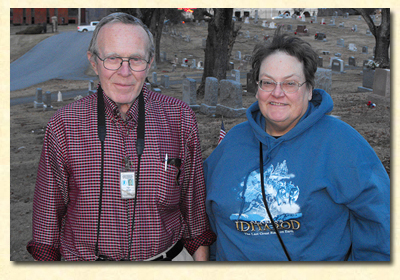
Ron and Sharon Fine - Find A Grave Contributors

Back in June while at Jefferson Memorial Park, in Pleasant Hills, PA, I was searching for some graves of cousins. A fellow walking through the same section was looking for a specific grave number. We figured out where his intended grave was located and he found it just paces away from where I was taking photos. He mentioned that he was taking pictures graves of specific veterans for what else – posting on Find A Grave. I told him I was there for the same reason; however, the objects of my photos were family members.

You never know who you might meet in a cemetery – if they have a camera, they may be a Find A Grave volunteer who is simply extending the database of online memorials or fulfilling a request for a photo of a grave. You may never know who you might dig up until you Find A Grave.

Saturday, August 21, 2010

Got Scots?

 
Last week I discussed some of the folks that I have met via the Internet over the last several years that allowed each of us to expand our ancestral knowledge. Cousin “L,” one of my synergistic relatives, recently pointed me to a web site that provides Scottish parish and probate records. The site is called “Scotland’s People” and is “the official government source of genealogical data for Scotland.” You will find it at http://www.scotlandspeople.gov.uk/.

Overview

There is one danger -- the site is addictive. If you have Scottish ancestry and know the general location of where your forebears lived, you might be able to expand your horizons and extend your generational reach. Some of the records, such census records, are available elsewhere. Even abstracts of some parish registers can be obtained on other sites; however, “Scotland’s People” allows you to access the actual documents. In addition, complete probate records are on file.

Unfortunately, searching some of the records and accessing all of the records has an associated cost. To do either, you must register as a member. Credits may be purchased in increments of 30 for £6 – which is roughly $10.00 American. You can purchase the credits via a credit card. One word of warning, the site would not process my debit card; however, it readily accepted my credit card.

When you perform a search, it is necessary to narrow the search as much as possible. This may be done by having both first and last names of the individual, the county and specific parish locations, and a range of years. Even with common names, I found it helpful to use the Soundex feature as one of my Wilsons was enumerated as Willson and I missed him the first time I searched for his birth record.

When you search for a name and it returns a number of pages, expect to pay one credit for each page. This will use up credits quickly if you don’t manage your searches well. Each parish document costs five credits each. The wills are somewhat different in that they can be searched for free and the entire will can be purchased each for £5 sterling. I had mistakenly thought that it was £5 per page; however, the price is for the entire document.

Incidentally, when you purchase searches and documents, these remain available for a period of time at the site without additional charge and both may be downloaded.

Where there’s a will, there’s a way

One of the aspects I’ve learned about Scottish wills is that there are specific, dialectal, and archaic terms in use that you will need to define. In addition, as with many legal documents, sometimes Latin is used for specific designations. Below, I have listed some of the terms you may encounter.

  • Testament dative – executors appointed by the court where there was no will and the testament dative is the document that is produced in absence of a will.
  • Heritable property – real property including land and buildings. These cannot be bequeathed in a will.
  • Movable property – all personal property that could be sold to honor debts and from which would be passed onto the heirs.
  • Goods and gear – personal property
  • Brother german – full brother
  • Brother uterine – half brother who shares the same mother
  • Brother agnate – half brother who shares the same father
  • Umquhill (Umql.) – the late
  • Defunct – the deceased
  • Decerned – decreed by the court


A great help in understanding Scottish wills and the handwriting of the period is ScottishHandwriting.com. Without this site, I would have been lost in understanding some of the documents.

For a look at an actual will and my transcription of it, click here.

Old Parish Registers

These records are invaluable in proving paternity and finding dates of births and christenings (baptisms), marriages, and burials. When you see these records, you will need to remember that these are Church of Scotland records and were not specifically intended for genealogical purposes. With that said, they can be a source of additional information for ancestor hunters.

Birth/Baptismal Records

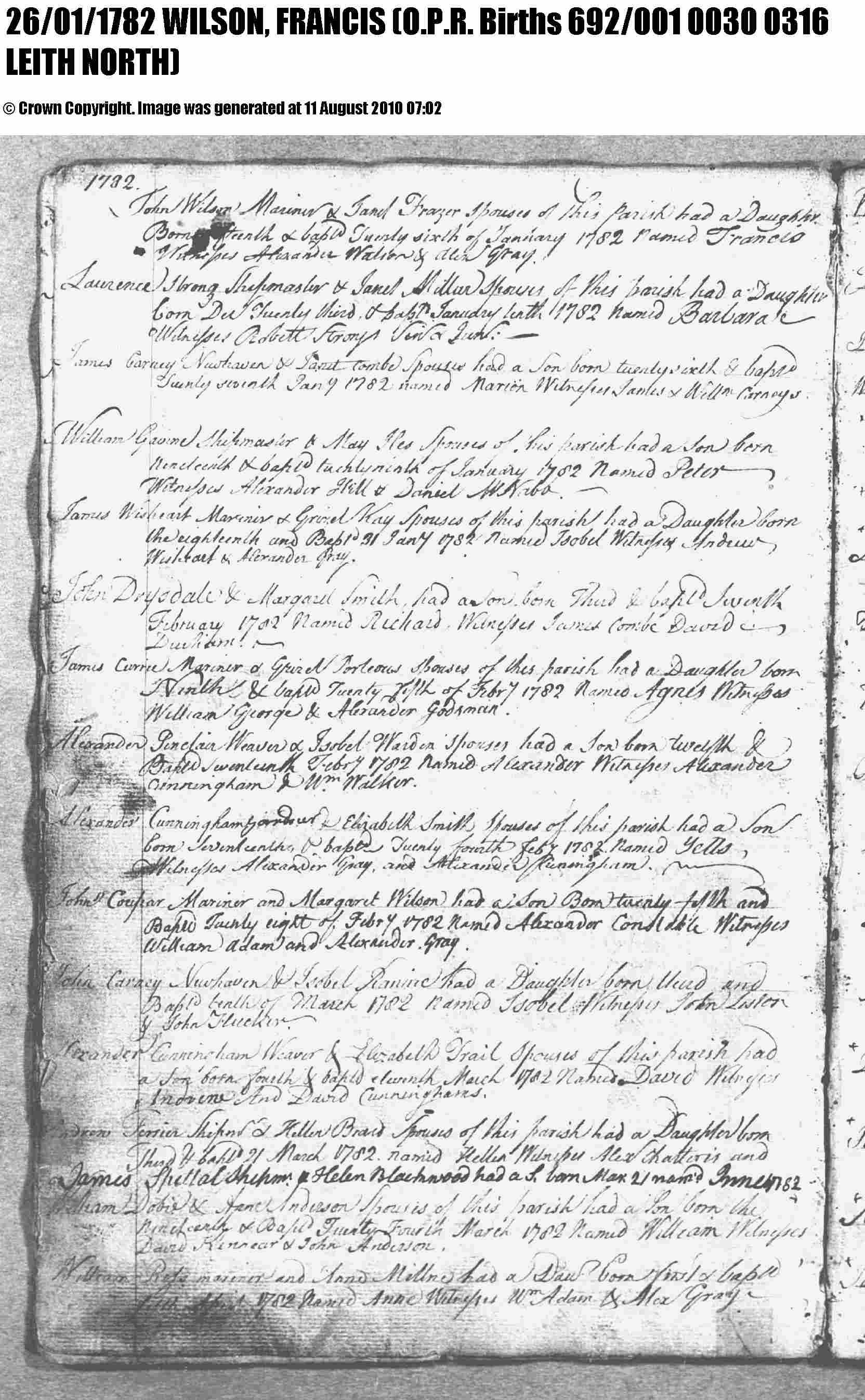
Dates of birth and death may be missing from the register as the dates for baptisms and burials were regarded as more important. While missing in some, they do appear in other documents. My 3rd great grandmother’s birth/baptismal record from 1782 reads: “John Wilson, Mariner and Janet Frazer, spouse of this Parish had a Daughter born fifteenth and baptized Twenty sixth of January 1782 named Frances. Witnesses Alexander Watson & Alen Gray.”

Portrait and birth record of Frances Wilson (later Owston)
Click photo for the document.

While I had seen this parish record twenty years ago on a microfilm I ordered from the Latter Day Saints Family History Library, I was able to download a digital copy of the record from “Scotland’s People.” The whole page is downloadable so if there is more than one record of interest, you will get them both. I did have this happen twice with two relatives found on the same page.

Marriage Records

Information in the marriage records will vary and may include the names of the parents, the occupation of the groom, witnesses, and other pertinent information. Some may be extremely complete and others may be woefully incomplete. The document may include information concerning the proclamation of banns – which is an announcement during a regular church service that gives the parish members an opportunity to object to the forthcoming marriage. The record may also reference the issuance of a license of marriage.


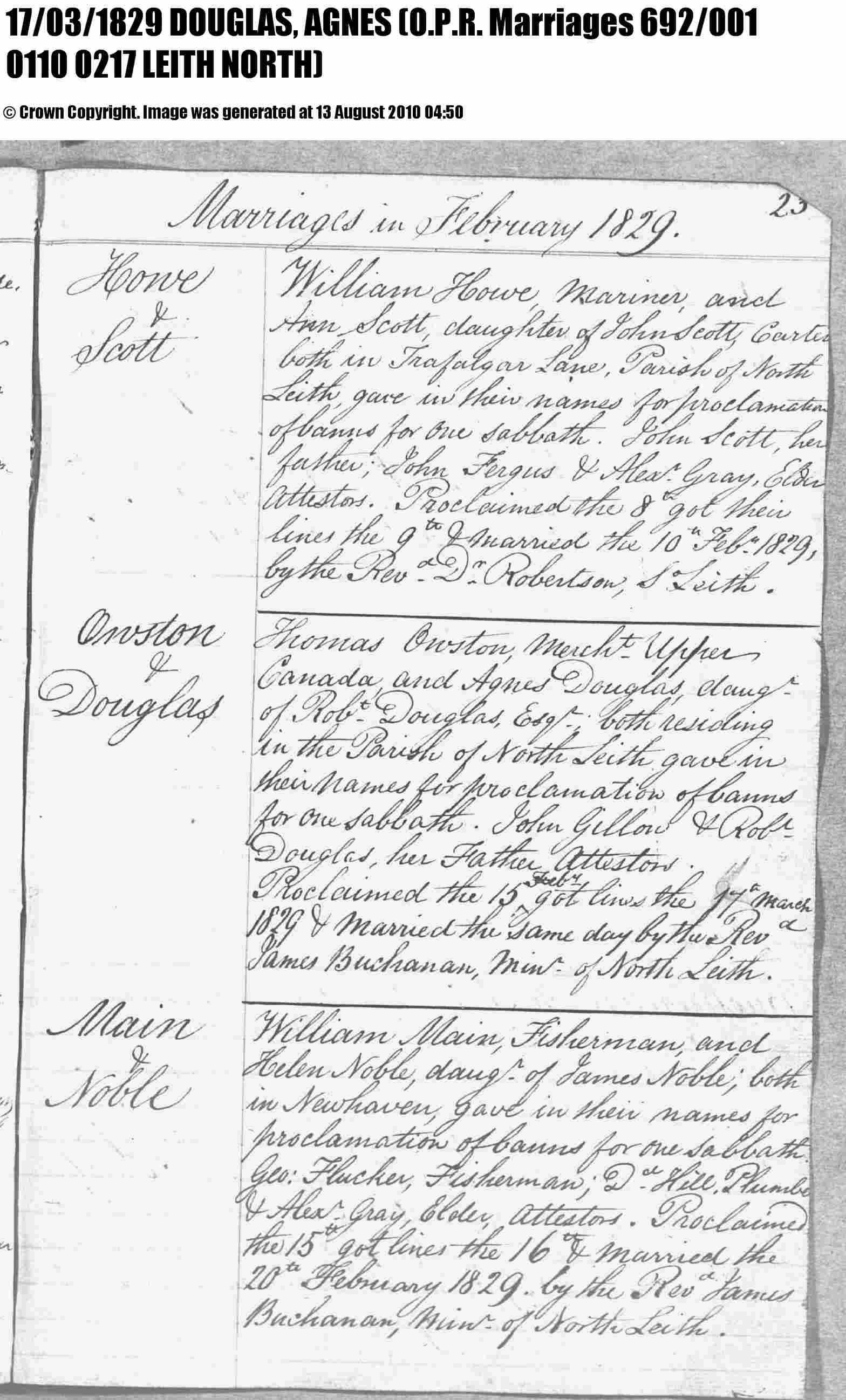
Portraits and marriage record for Thomas Owston & Agnes Douglas
Click the above photo for access to the document

“Thomas Owston, mercht. of Upper Canada [Ontario], and Agnes Douglas, daugt. of Robt. Douglas, Esq. both residing in the Parish of North Leith gave in their names for a proclamation of banns for one Sabbath. John Gillon [first cousin of the groom and brother-in-law of the bride] and Robt. Douglas , her father attestors. Proclaimed the 15th Febry; got lics. [license] 17th March 1829 & married the same day by the Rev. James Buchanan, Min. of North Leith.”

Death and Burial Records

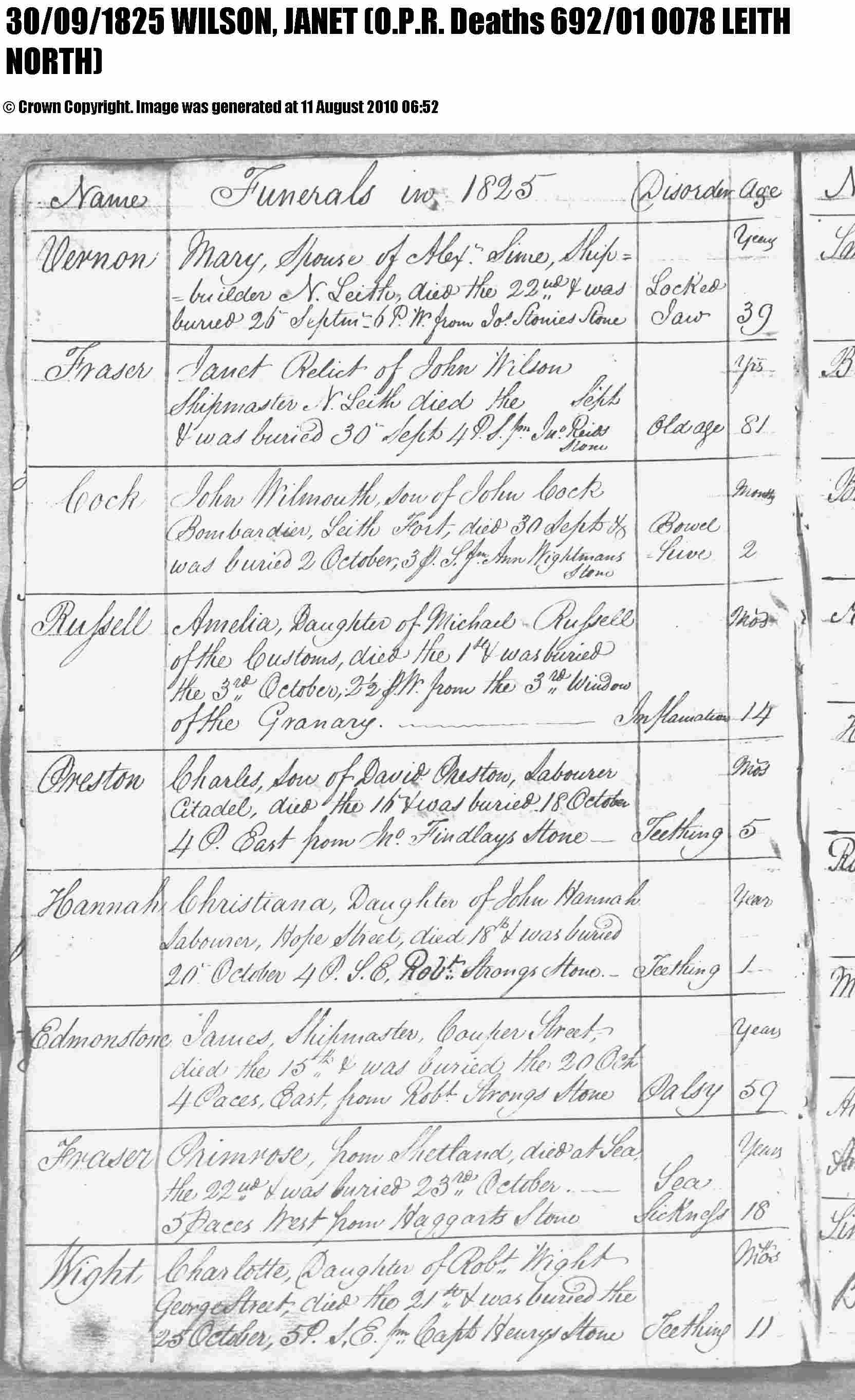
Since the church did not require burial information to be registered, some parish registers only have deaths for the 19th century. Earlier deaths are not recorded. In addition, where you find records a woman’s maiden name is used more often than her married name. In the following death record for my fourth great-grandmother, she is listed as “Fraser, Janet relict (widow) of John Wilson, Shipmaster, died the ___ Sept. and was buried 30th Sept. [1825]. 4 P[aces] S[outh] from Jno. Reid’s stone.” She died of “old age” at the age of “81.”

Portrait and death record for Janet Fraser Wilson
Click the above photo for access to the document

While her date of death is not listed it is reasonable to say that she died two to three days prior to the burial on September 30, 1825. Extant copies of the Edinburgh Current do not list her death information; therefore, knowing her exact date of death is impossible at the present.

It is interesting to note that she was buried four paces south from the stone of John Reid in the North Leith parish cemetery on Coburg Street in Leith. The location of the plot may indicate that there was no stone erected for the grave. Ironically, her daughter (my 3rd great grandmother) was buried in Cobourg, Ontario.

Other Records

The site has other records that I have not had a need to check as these do not apply to my family. These addition records include the decennial censuses from 1841 to 1901; the statutory registers for births, marriages, and deaths for the years 1855 to 2006; Coats of Arms; and Catholic parish registers.

My Experiences

I was able to tighten up my family tree and learned that some information of another researcher who had submitted his data to International Genealogical Index (IGI) was incorrect. At the time, I had contacted him and he sent me his complete family record sheets and when I did a preliminary check of the parish registers, I thought he was correct -- we were both wrong.

The will of my fourth great-grandfather provided by Cousin "L" had information concerning the date of death of this ancestor, that his son John had predeceased the Testament Dative, and the name of my 3rd great grandmother’s oldest sister’s husband was recorded incorrectly by my 1990 contact.

The other researcher (as I did in 1990) assumed that another Janet Wilson who was married in the parish was the daughter of John Wilson and Janet Fraser. It was not the same Janet Wilson. The correct marriage, however, was documented in the records of St. Cuthbert's Parish of nearby Edinburgh.

There were other mistakes found in the other researcher’s analysis of the parish registers that I was able to correct in my family tree. In addition, I was able to take two lines back further in time and added to my ever growing list of ancestors.

Cautions

As with any genealogical record, take notice of others in the parish that have the same name. This was one of the errors that my contact from 1990 had made in his research. This is easy to do.

In searching the records for further information regarding my fifth great-grandfather named John Wilson, I discovered that there were as many eight adult John Wilsons that were possibly alive in 1760. One of these was my fifth great grandfather and one was my fourth great grandfather. One could possibly be my sixth great grandfather; however, I neither have his name nor any information about him.

I alluded to a second problem with the site. It can be addicting and therefore, you may be finding that you are spending more than you initially expected. For most genealogists, these additional costs will be part of the normal behavior associated with the hobby.

Thanks Cousin "L" for letting me know about this site.

Got Scots?, good luck.