Saturday, June 16, 2012

Genealogy by the Numbers: Confirming a Relationship with DNA

There have been few items in the genealogist’s toolbox that can demolish those ever present brick walls; however, one that I have learned to depend upon to help solve some puzzles is DNA analysis. To date, four personal genealogical brick walls have collapsed through the use of both Y-DNA and autosomal DNA testing. Some of these dead ends could not be settled with almost 35 years of traditional research as documentation did not exist.

Last week, autosomal DNA testing solved a mystery that I have been pondering since I discovered a relative at the Boston Public Library in 1988. Named Ruth Day, this woman could have been my father’s half-sister, first cousin through his Aunt Susie, or first cousin through his Aunt Lydia. While I had a theory on her relationship to my father, I could not confirm my suspicions until DNA analysis indicated a solution to this genealogical quandary. This was confirmed by the numbers in light of other family information.

By comparing the amount of autosomal DNA shared between relatives, it is possible to estimate a relationship. Recombination of autosomes occurs randomly; however, as the amount of DNA shared between individuals lessens, the ability to predict a relationship with some accuracy becomes more difficult. For those who have shared DNA with my own family at under 0.75%, some of the relationships are quite distant. Steve Mount has a blog post that explains this very well.

To date, I have been able to confirm only three heretofore unknown relationships – a seventh cousin; a double 9th cousin, once removed; and a 12th cousin, twice removed. These relationships are quite distant and some share more DNA with me than those with known relationships. So predicting at lower levels is a gamble, but predicting approximate relationships with a higher percentage of DNA is possible.

With that said, two individuals from an endogamous group (such as Ashkenazim) will have a higher shared percentage of DNA with more distant relationships. Even those with Colonial ancestry might have higher shared DNA percentages than indicated and that may explain the three distant relationships mentioned above as all three are related to me through my grandmother’s New England colonial ancestry.

Autosomal DNA Shared Between Close Cousins

With each generation, the average amount of shared DNA decreases by half; however, because recombination is random, this number is not exact. For example, I share at a less than average amount of DNA with one of my brothers – 41.00%. His son and I share only 14.90% of our DNA – a difference of 63.7% less than the preceding generation. With the range is outside of the normal range for a nephew, 23andMe calculates us as first cousins.

Add another generation with my daughters and the percentages tend to right themselves. My youngest daughter and her first cousin share 9.13% of their DNA – a difference of 38.7% from the preceding generation – indicating that a more than average amount of DNA was retained with this next generation – although lower than the average 12.5% estimated share. My other daughter shares 7.38% with her cousin, which is a very low share for a first cousin; however, she retained 50.5% of the DNA that her father and cousin shared.


Following a normal curve, statistically 68.2% of all matches should occur within ±1 standard deviation (σ) from the mean score. The following chart indicates the ranges of ±1 standard deviation from the mean for each degree of relationship from first to third cousins.


Since there are a variety of relationships that fall within these ranges, I have identified the percentages according to the degree of relationship between the two subjects. These are based on the civil definition of degrees of relationship which is calculated by adding the total distance from the common ancestors for both subjects. Half first cousins have the same civil degree of relationship (4) as full first cousins; however, the amount of DNA shared is less and appears to be the same as first cousins, once removed (a degree of relationship of 5).

 Relationship DNA Degree 
 of Relationship 
 First Cousin4
 First Cousin, Once Removed5
 Half Cousin*
 Second Cousin6
 First Cousin, Twice Removed
 Half Cousin, Once Removed*
 Second Cousin, Once Removed7
 First Cousin, Thrice Removed
 Half Second Cousin*
 Half Cousin, Twice Removed*
 Third Cousin8
 Second Cousin, Twice Removed
 Half Second Cousin, Once Removed* 
 Half Cousin, Thrice Removed* 


*half cousins have a degree of relationship one step higher; however, they share DNA with relationships of a lower degree.


Finding Ruth Day

During spring 1988, I took a marathon research trip that took me to Newark and East Orange, New Jersey; Boston, Massachusetts; Concord and Claremont, New Hampshire; and Pittsburgh, Pennsylvania. During that journey, I had the opportunity to visit the Boston Public Library and was able to find my great-grandfather (Thomas Day) in the soundex for the 1880 and 1900 census records for New London County, Connecticut.

In the 1900 census, I discovered that his household contained a nine-year old granddaughter named Ruth Day. This was the first time that I encountered this name and really didn’t know how she was Thomas’ granddaughter. Since Thomas had three daughters and no sons, there were three primary possibilities of how she could have been related to me.

Although I pondered this over the years, I didn’t think much about it until I visited the National Archives in July 2009. During this trip, I decided to have Thomas Day’s Civil War pension record pulled for a second look. I had accessed it in February 2000 and it provided me very critical information that helped me enlarge my family tree. While looking at the documents, I noticed that Ruth Day was utilized by her grandfather as a witness to his documentation. The final entry that she witnessed was on March 9, 1907. Her address was listed as being North Stonington, CT.

Not being able to find her under Ruth Day in the 1910 census, I assumed one of three scenarios: she had relocated, got married, or had died. I assumed that she must have married. I repeated my search to find a married woman by the name of Ruth who was born from 1889-1891 and who was living in North Stonington, CT.

Three possible married women named Ruth from New London County were returned in the search on Ancestry. While one lived in Lyme and another lived in East Lyme, the third was living in Stonington. Ruth Tillinghast, the wife of Walter B. Tillinghast, seemed like a prime suspect to be my Ruth Day. I searched her husband’s name and found him among the family trees posted on Ancestry with his wife “Ruth Day.” In addition, I learned about the story of their son Julius who, at the age of 4, was adopted out because his mother never bonded with him. Julius Tillinghast became J. Russell “Russ” Deckard.

Russ Deckard Chief Radio Officer, SS Evangeline, 1941, World War II

The tree was managed by Deckard’s son Gerald, and he included the transcript of the letter sent by Russ’ birth father to his adoptive father.
Mr. Deckard,
I had no trouble getting Mrs. Tillinghast to sign the paper. I saw her about an hour and she did not mention his name even how he was or where he was or who was to adopt him. It makes me feel bad the interest she has shown in him but it is God’s will. I believe he knows best. You need not worry about her ever trying to see him for she won’t know where he is or who has him. I myself feel bad to do this but think it is the best for him as his mother takes no interest in him. I shall not try to see him here after. I was in the insurance office at Westerly but they had sent my book Saturday morning to the city so you will have to go the insurance office here in the city have it changed for yourself for I may not get the book before I go away but if I do and have time I will make them fix the book and policy. The next premium will be due the 20th of May next as I paid it in advance yesterday 9 weeks. I would like it to have paid 1 year in advance but could not on account of money. I am to have no money for two months in Kavey (???) as they would hold one month back.

P.S. Mr. and Mrs. Deckard. I can never thank you enough for this kind and charitable deed you have done for me and mine and hope you people never have cause to regret it. I also hope you have no trouble to train him to your likes and dislikes.

I remain your respectfully Walter B. Tillinghast

Additional searching provided me further information regarding Ruth Day including her death at 45 in Rochester, Minnesota. I purchased her death certificate online and it arrived a few days later. Her tragic end was detailed by the attending physician. It appears that Ruth fractured her right femur during a fall in 1933. In late January 1935, she had a bone graft operation at the Mayo Clinic because the break was not joining together; however, she developed a pulmonary embolism following her operation and died. In time, her husband remarried.

Even though her approximate birth date and location were known, her birth did not appear to be registered. I could not be certain on which one of the Day sisters was Ruth’s mother. Although I knew more about her in 2009, my ability to determine the identity of her mother had not changed since I discovered her existence 21 years earlier.

Daughter of Susie Eva Day?

As I analyzed the data, her birth on December 22, 1890 at Gales Ferry, CT, and other data helped narrow the possibilities. It would be unlikely that she was Susie’s child, as Susie was married at the time and would have been pregnant with her second child Myrtle in December 1890.

Susie and John Merriman with their youngest child, Lawrence Raymond Merriman

Myrtle Merriman was born in May 1891. If Myrtle was premature, it is possible (but highly unlikely) that Susie could have given birth to both girls in that short period; however, there is also question regarding Ruth’s birth year. The 1900 census lists her being born in December 1890; she is also listed with the following ages on her last birthday during the following census: 1900 – 9, 1910 – 19, and 1920 – 29 – all corroborate an 1890 birth year.

The 1930 census and her death certificate, however, indicate she was born in 1891. If this were the case, her birth 7 months after Myrtle’s could be believable, but not very probable. With Ruth having the name of Day, it is another strike against her being Susie’s daughter as she was already married to John Merriman at the time of Ruth’s birth.

Daughter of Lora Gardner Day?

Although Susie could be eliminated by the virtue of her own pregnancy, this was not the case with the second daughter Lora – my grandmother. In my mind, she was eliminated because in 1904 she gave birth to the fifth of her sixth children and named this daughter as Ruth E. Dalton. While it is possible to have two or more children with the same name (ask George Foreman), it wasn’t very probable.

Lora with her youngest child: Charles Ellsworth Owston

Daughter of Lydia D. Day?

As far as I was concerned, Lydia, the youngest daughter of Thomas and Amy Day, was the best candidate for being Ruth Day’s mother. Lydia was born on September 10, 1875 and she would have been 15 years old when Ruth was born. Although younger than her sisters, circumstantial evidence pointed toward Lydia; however, I had no proof that she was the rightful mother of Ruth Day.

On Ruth’s death certificate, a mother isn’t listed; however, Thomas Day was listed as her father. A birth certificate for Ruth Day was not found at Ledyard which includes the village of Gales Ferry. Although Thomas Day is listed on the death certificate for Ruth, it does not appear that he was her actual father. In the 1900 census, she is listed as his granddaughter and in various documents in his Civil War pension file, she is not listed among his children.

Lydia (left) with sister Lora; identity of the baby is not known

Of the sisters, Lydia is the one of which I know the least. She was the first of the three to pass away (August 1931) and she is the only one of the three to divorce a husband. She married Frank Ernest Botham circa 1892. One child, Elmer Ernest Botham, was produced from the union in 1893. It is uncertain when she divorced, as in an affidavit dated April 14, 1898, her father lists her as Lydia Botham and that she was married. In the 1900 census, Frank Botham was listed as still being married and having been so for eight years – even though Lydia was married to someone else by then.

When she married William Henry Gorton in 1898, it appears that custody of her eldest son was retained by his father. The relationship she had, if any, with Elmer Botham is currently unknown; however, it appears to be negligible at best. He is not counted among her children in the 1900 and 1910 censuses. Four children were produced from her second marriage and included William H. Gorton, Jr. (1899), Henry Reynolds Gorton (1902), Mary Gorton (1904), and Elmore Gorton (1907). It appears that young Elmore died prior to the enumeration of the 1910 census.

Being the youngest child of Thomas and Amy Day, Lydia was not quite 13 years of age when her mother passed away. During her critical adolescent years, a mother’s influence was absent, and this may have had a profound effect on Lydia. If she were Ruth’s mother, her pregnancy occurred in less than two years from the time of her mother’s death.

Since the rearing of Ruth was consigned to her grandfather and Lydia’s child Elmer was raised by his father, it creates an interesting picture of Lydia’s psychosocial development. This same abandonment scenario appears to have occurred with Ruth and her son Julius and therefore, the behavior could be considered cyclic. That is, if Lydia was her mother – but neither Susie nor Lora had similar experiences with their children. In fact, Susie took in a grandchild and raised him as her own.

Unfortunately, psychosocial similarities are not accepted proofs of descent. Without a birth certificate to prove Ruth Day’s maternity, I was back to square one – I knew she was related but not how. In August 2009, I messaged Gerald Deckard through his Find A Grave account to attempt to make contact with this newly found cousin; however, he did not discover my message until January 2012. After a series of emails, we decided to try the autosomal DNA route to see if a specific relationship might be confirmed.

Shared DNA Segments

By using induction, we should be able to confirm the relationship between Gerald and others who are descended from Thomas Wesley Day and Amy Alice Champlin. The amount of shared DNA among the subjects should be indicative of their relationships. In addition, the percentage of shared DNA should fall within ±1 standard deviation of the statistical mean for that relationship.

Although I do not have contact with any known descendants of Lydia, we do have DNA results from seven descendants of Lora and two descendants of Susie. For the purpose of this analysis, we will consider the five closest matches. If Ruth were the child of Susie or Lora, then the relationship between Gerald and the appropriate subject would be that of a half cousin, once removed.

The amount of DNA shared by half cousins, once removed would average at 3.13%. The range within ±1 standard deviation would be 2.06% to 4.20 %. Extending that range to ±2 standard deviations would increase the range from 1.63% to 4.62%. Theoretically, 95.4% of all matches within this close relationship should fall within this range. Even at ±3 standard deviations, the percentage shared ranges expand to 1.57% to 4.69%. Nearly all matches (99.7%) would fall within ±3 standard deviations.

If Ruth were descended from Lydia, Gerald’s relationship with the others would be diminished to that of a second cousin, once removed. The amount shared for this relationship averages at 1.56%. The ranges for this relationship would be 1.03% to 2.10% ±1 standard deviation and a range of 0.82% to 2.30% with ±2 standard deviations.

Subject Grandmother  Amount of 
 Shared DNA 
 Jim Lora1.47%
 Chuck Lora1.29%
 Suzanne Susie1.17%
 George Lora1.15%
 John Lora0.92%


Although more samples from Susie’s line at the grandchild level and samples from Lydia’s known descendants (if any exist) would have been optimum in confirming Ruth Day’s maternal ancestry; however, by combining the information we currently know with the amounts of shared DNA, we may be able to infer that Ruth’s mother was Lydia.


Four of the five subjects are grandchildren from Lora and three of these subjects' results fall within ±1 standard deviation. A fourth, John, falls within ±2 standard deviations. There are enough samples here to confirm that Ruth Day was not the daughter of Lora Gardner Day and that her own daughter Ruth E. Dalton was probably named for this cousin.

As for Susie’s descendants, we only have one sample from a grandchild; however, since that number falls within ±1 standard deviation for a second cousin, once removed; it is likely that the suspected relationship is accurate. Suzanne falls completely outside of the realm of a half-cousin, once removed even with ±3 standard deviations from the mean for the higher relationship. Even if she were an outlier, it would be expected that that the numbers would be higher for a supposed closer relationship. Two of Lora's grandchildren have higher results.

As mentioned earlier, there are four other individuals that have been tested at 23andMe from this family: three great-grandchildren of Lora and a second great-grandson of Susie. The descendents of Lora should be related to Gerald as third cousins and Susie’s great-great-grandson, Craig, should have a relationship as a third cousin, once removed.

 Subject  Ancestor  Amount of
 Shared DNA 
LoraLora0.81%
CraigSusie0.79%
 Kristen Lora0.63%
MichaelLora0.00%


As more distance is placed within a specific relationship, it is my experience is that it becomes more difficult to predict the suspected relationship. The average estimated DNA shared at the third cousin level is 0.78% while a third cousin, once removed would be 0.39%. It is also estimated that only 90% of third cousins will have shared DNA. That percentage drops to 0.45% at the fourth cousin level.


In the case of these family members, Michael shared no DNA with his suspected third cousin – but among the previous generation, Michael’s father had the least amount of DNA shared with Gerald. Lora and Kristen both fell within a ±1 standard deviation; however, Craig shared nearly twice as much for a third cousin, once removed. His results appear to be like that of a third cousin. He also has five shared segments.

Conclusion

Although Craig’s unusually large match might implicate Susie as Ruth Day’s mother, other factors include the amount of DNA shared between Suzanne and Gerald and Susie’s pregnancy with Myrtle that overlaps the birth of Ruth.  This evidence appears to eliminate the slightest possibility that Susie was Ruth’s mother.

With four grandchildren of Lora sharing with Gerald at a relationship consistent with second cousins, once removed, she is eliminated by virtue of the lower numbers. The fact she also had named her daughter Ruth in 1904 adds weight to this argument.

Although samples from Lydia’s line and additional samples from Susie’s grandchildren would provide further data and make the case stronger, I believe by combining the circumstantial evidence with the amount of DNA shared suggests that Lydia was Ruth Day’s mother. I have always assumed this, but had an inability to confirm my hypothesis.

DNA analysis in this regard helped break down a brick wall in our family tree; however, enough other data was present to lead to this confirmation. Some close DNA matches, however, may not be able to suggest a relationship without the presence of other data. A suggested relationship by the numbers, however, may provide an impetus to look for the relationship in the correct direction; and thus, shared DNA can add to the body of genealogical evidence in determining one’s relationship with another individual.


Monday, June 4, 2012

Remembering the Civil War Dead: Part 2


As an alternative to the “shield” type Civil War stone discussed in the previous installment, the federal government provided a simpler “slab” type of marker for Civil War vets. Some of the same companies that produced the “shield” marker also produced the “slab” headstone.

The typical marker had the soldier’s name, regiment, and date of death that were carved as a bas relief style within a rectangle. Unfortunately, these stones were particularly vulnerable to the elements in industrial areas. A simpler version of the stone had the information cut into the white marble. 

In the Pittsburgh region, many of these stones are currently illegible due to the sulfur dioxide emissions as a byproduct of steel production. When the sulfur dioxide mixes with precipitation, it creates acid rain. This is disastrous to marble and limestone which causes the inscriptions to become illegible and the stone itself begins to flake. You will notice that several of the stones in this installment have suffered great damage.

As with last time, we will look at several examples of government supplied “slab” type tombstones. All are from one regiment, the 9th Pennsylvania Reserve Volunteer Corps – also known as the 38th Pennsylvania Volunteer Infantry. Except for one, all come from the Greater Pittsburgh area and all were photographed by the author during 2004. The men honored provide a cross section of service in the regiment and a brief description of their lives follows.

Joshua Bain

Joshua Bain at Culpeper National Cemetery, Culpeper, VA

One of the simpler versions of the standard “slab” type of governmental tombstone can be found at Culpeper National Cemetery in Culpeper, VA. The grave for Joshua Bain was photographed on June 14, 2004. A resident of the former Penn Township in Allegheny County, the 5 foot, 4 ¼ inch Bain was a coal miner by trade when he joined the McKeesport Union Guards (Company I) on June 18, 1861.

As did many of the men in the Pennsylvania Reserves who had seen battle in the Seven Days and Second Bull Run Campaigns, Bain straggled behind as the regiment was getting in line of battle for the Maryland Campaign. By doing such, these stragglers missed the battles of South Mountain and Antietam. The stragglers in the division were summarily court martialed at the regimental level and were fined for their lack of participation.

Because of the large numbers of stragglers, these men had to be punished, but not put through the process of a general court martial. Typically, these actions were called “drumhead court martials.” Bain was fined $10 for his absence and this was to be deducted from his pay on October 31, 1862. While $10 does not seem like much in today’s economy, the monthly pay of a private in the US Army was $12. Therefore, 83% of a soldier’s pay for one month was significant.

While Bain had not always been a stellar soldier, his place of burial in a national cemetery speaks to the ultimate sacrifice that he paid. While on picket duty along the Orange and Alexandria Rail Road near the Forks of the Rapidan River, Bain was killed by Rebel cavalry. Originally buried near the rail road, his body was reinterred at the national cemetery.

John Vickeroth

John Vickeroth at South Side Cemetery, Pittsburgh, PA

Born as Johannes Vickeroth in Hebel, Homburg, Hesse-Kassel, John Vickeroth, as he was to be known in America, was the illegitimate son of Martha Elisa Hausmann and Johannes Vickeroth. As he immigrated in 1848, he was probably among the number of German men who were dissatisfied with the lack of change after the March Revolution in the 39 states that comprised the German Confederation. Desiring additional freedoms, the Forty-Eighters came to America in droves. Like John Vickeroth, many of these men participated in the Civil War.

Vickeroth was among the first enlistees in Conrad Feger Jackson’s company of the City Guards, Company B. Later as the company was incorporated into the 9th Pennsylvania Reserve, it became Company G. A carpenter by trade, the 5 foot 11 inch Vickeroth participated in the early battles of the Army of the Potomac. He was shot in the left thigh and was captured at Charles City Crossroads on June 30, 1862.

He was released on parole on July 22, 1862 and was hospitalized following his return to the Union Army. He wound resulted in a “Limitation of motion of left thigh, leg, and foot” and his “Lameness prevented him from marching.” On December 2, 1862 he was discharged on a Surgeon’s Certificate of Disability being one-fourth disabled. Although he immediately filed for a pension, it would not be granted until 1869.

Vickeroth was married to Elizabeth Keil (in 1863) and Eliza Schilling (in 1887) and outlived both wives as well as four of his six children. One of his children, his namesake son, lived only a day and one half dying of a brain compression due to forceps delivery at his birth in 1875.

In September 1906, John Vickeroth sought and was granted citizenship by virtue of his Civil War service. He died on June 3, 1911 and was buried in the South Side Cemetery in Pittsburgh. The stone was photographed on October 8, 2004. His marker is one of the better examples of the “slab” type in the Pittsburgh area as it can be easily read. The cemetery's location on the south side of Mt. Washington away from the direct exposure of the mills along the Monongahela River may have protected it.

Edward K. Davis


Edward K. Davis at Grove Cemetery, New Brighton, PA

Edward K. Davis was the son David and Sarah A. Davis of Fallston, Beaver County, Pennsylvania. While records of his age vary with different records, the 1900 census suggests that his birth occurred in July 1841; however, earlier records indicate that he probably was born between 1838 and 1840. A blacksmith by trade, he enlisted in the New Brighton Rifles (Company H) on April 19, 1861; however, his tenure with his unit was slightly over one year in duration.

On December 20, 1861, the 9th Reserve was engaged with the enemy at Dranesville, Virginia in what would become the first victory of the Army of the Potomac. During this battle, Davis received a gunshot wound to the left leg. He was one of several members of the regiment that General E.O.C. Ord recommended as “worthy of a certificate of merit for . . . bravery and gallantry.” Following his injury, he spent most of the time in the division hospital and on furlough back to Beaver County. Upon his return, he was sent to the general hospital on March 6, 1862.

Because his wound hampered his ability to march, he was discharged on a Surgeon’s Certificate of Disability on April 30, 1862. Davis returned home where he married, fathered seven children, and worked in a variety of jobs. By 1890, the Davis family moved to Allegheny County. He died in Swissvale on January 9, 1913 and was survived by his widow and three children.

His remains were taken home to Beaver County where they now rest in New Brighton’s Grove Cemetery. The above photo was taken on June 29, 2004. The stone shows the flaking of gypsum that occurs when acid rain contacts stone high in calcium carbonate.  In addition to the marker a GAR ceramic flag holder is seen in the photograph. Each of these were numbered and the local post kept a record of the soldier's service and his date of death.

Jacob Coneby 

Jacob Coneby at St. Mary's Catholic Cemetery, Munhall, PA

Born on May 1, 1835 in Baltimore, Maryland, Jacob Coneby was a coal miner residing with James and Hanah [sic] Flinn in Baldwin Township, Pennsylvania in 1860. Because of the location of his home and that he enlisted in Robert Anderson’s Government Guards on May 15, 1861, it is thought that he may have belonged to a segment of men who were an overflow of the McKeesport Union Guards. Many of the men from Company D were from McKeesport’s sphere of influence and could have helped alleviate the deficit of men found in that company.

Private Coneby participated in all of the regiment’s battles through the Maryland campaign where he was wounded at Antietam. For a short period of time, he was detached to the regiment’s ambulance corps, but was reassigned as regimental teamster by Lt. Col. James McKinney Snodgrass on February 15, 1863. He remained in that position until muster out in May 1864 and participated in no further engagements.

He returned to coal mining following the war and was a charter member of Homestead’s General Griffen Post #207 of the Grand Army of the Republic in May 1881. Not remaining current with his membership, he was dropped from the rolls of the post in 1884.

Coneby married his wife Mary Jane in 1864 or 1865 and the couple produced one daughter, Laura. The 1900 census indicates that Mary Jane had another living child as well. By 1910, Jacob was a widower and was living with his daughter and son-in-law William Hickman.

Coneby died at Hays (now Pittsburgh) on November 13, 1913 and was buried in St. Mary’s Cemetery in Munhall, PA. The deterioration of his marker is typical of what is found in the Pittsburgh area. This stone was photographed on October 8, 2004. It is nearly illegible except for the name of "Jacob"; however, this stone shows less of the characteristic gypsum flaking.

Thomas W. Kirkwood


Thomas W. Kirkwood at McKeesport-Versailles, McKeesport, PA

Born circa 1841, Thomas W. Kirkwood was the son of Samuel and Lucinda Kirkwood of McKeesport, Pennsylvania. Although throughout his life he worked in a variety of occupations, the younger Kirkwood was a cigar maker at the time of his enlistment in the McKeesport Union Guards in 1861.

At Beaver Dam Creek on June 26, 1862, Kirkwood was captured by the Confederate Army. During his incarceration at Belle Island Prison in Richmond, he contracted typhoid fever which significantly weakened his constitution. He was paroled on August 8, 1862 with other sick and wounded Union soldiers and was sent for treatment on a hospital ship anchored at Fortress Monroe, Virginia. He returned to Company I in October 1862 and participated in all of the subsequent campaigns of the regiment without incident.

Following the death of his wife Hannah in 1881, he applied for a pension as he found it difficult to work a full time job due to his health. When the pension laws changed in 1890, he was granted his request; however, he only benefited from it for a short while – if he benefited from it at all. McKeesport-Versailles Cemetery records indicate that he died on December 2, 1891; however, since Lee Brothers provided the stone under contract dated September 5, 1891, it is likely that his death actually occurred in 1890. His pension was canceled shortly after it was issued.

His stone is one of the most exposed “slab” type markers that I have seen. The stones were between 30 and 42 inches tall and it was intended that only 12 inches would show above ground. In this instance, it appears that more than half of the stone is exposed. This stone was photographed on July 1, 2004. This stone was only found by comparing cemetery records for the section and determining that it was his grave. The name of "Kirkwood "is barely identifiable.

Felix Machalewski


Felix Machalewski at St. Wendelin Catholic Cemetery, Carrick, PA
The son of Ignatz Machalewski and Catharina Mushinska, Felix Machalewski was born April 25, 1843 in Konitz in the Kingdom of Prussia. His hometown is now known as Chojnice, Poland. While many of the soldiers in the 9th born outside of the United States came from the British Isles and various German states, Machalewski was the unit’s only Polish member. He immigrated to the America in August 1860, and in less than a year, he had tendered his service to the Garibaldi Guards (Company B) of the 9th Reserves.

At Charles City Crossroads on June 30, 1862, he received a gunshot wound in his left hand that required the complete amputation of his middle finger. He was sent to Davis Island, NY for hospital treatment. In April 1863, he was listed as deserting from the hospital. His whereabouts between the spring and fall 1863 are missing from his records.

He rejoined the regiment during fall 1863 and apparently his absence was not charged against him. He finished out his tour of duty and was mustered out with the regiment in May 1864. Additionally, he was granted a pension in 1871 for $3.00 a month for the loss of his finger. Based on his military service, Machalewski was naturalized as an American citizen in November 1864.

Although prior the to war Machalewski was employed as a butcher, he later worked in Pittsburgh’s glass trade. He and his wife, Julia Kempf (a native of Baden), were married at St. Mary’s German Catholic Church at Allegheny City (Pittsburgh’s North Side) on April 25, 1865. The couple had at least five sons; however, since the family cannot be located in the 1900 census, it is difficult to determine how many children they produced in total.

Machelewski died from gastric cancer on August 15, 1906 at 2237 Southern Avenue, Carrick, Allegheny County, PA. He was buried at St. Wendelin Cemetery on August 17. The photo was taken July 3, 2004. Still readable in 2004, the stone shows its age and acid rain exposure.

These six examples provide a look at the “slab” markers that mark the graves of Civil War soldiers. There are other examples that are completely illegible.  While several members of the 9th Pennsylvania Reserves are buried in McKeesport's Fairview Cemetery none of the dozen or so "slab" markers for Civil War vets can be identified without a concerted effort by using cemetery records.  I've attempted this; however, determining where one section ends and another begins in this old cemetery appears to be haphazard at best. 

References


Compiled Military Service Records of the 9th Pennsylvania Reserves; Records of the Adjutant General, Record Group 94; National Archives Building, Washington, DC.

Coneby, Jacob. Pension record #939.529. Civil War and Later Pension Files; Records of the Department of Veterans Affairs, Record Group 15; National Archives Building, Washington, DC.

Current Record of Headstones Provided for Deceased Union Civil War Veterans, 1879-1903, Rolls M-1845, National Archives Building, Washington, DC.

Davis, Edward K. Pension record #146.373. Civil War and Later Pension Files; Records of the Department of Veterans Affairs, Record Group 15; National Archives Building, Washington, DC.

Eighth United States Census (1860); Washington ,DC: National Archives and Records Administration.

Eleventh United States Census (1900); Washington ,DC: National Archives and Records Administration.

Kirkwood,Thomas W. Pension record #744.968. Civil War and Later Pension Files; Records of the Department of Veterans Affairs, Record Group 15; National Archives Building, Washington, DC.

Machalewski, Felix. Pension record #620.718. Civil War and Later Pension Files; Records of the Department of Veterans Affairs, Record Group 15; National Archives Building, Washington, DC.

Naturalization Petitions of the U.S. District Court, 1820-1930, and Circuit Court, 1820-1911, for the Western District of Pennsylvania; NARA Series: M1537; National Archives and Records Administration (NARA), Washington DC.

Ninth United States Census (1880); Washington ,DC: National Archives and Records Administration.

Records of the General Griffen Post #207 of the Grand Army of the Republic, Homestead, PA; Pittsburgh, PA: Soldiers and Sailors Memorial Hall.  

Regimental Records of the 9th Pennsylvania Reserves, Civil War Loose Record Files; Records of the Adjutant General, Record Group 94; National Archives Building, Washington, DC.

Seventh United States Census (1850); Washington ,DC: National Archives and Records Administration.

Special Schedules of the Eleventh Census (1890) Enumerating Union Veterans and Widows of Union Veterans of the Civil War; (National Archives Microfilm Publication M123, 118 rolls); Records of the Department of Veterans Affairs, Record Group 15; National Archives, Washington, D.C.

Twelfth United States Census (1910); Washington ,DC: National Archives and Records Administration.

Vickeroth, John. Pension record #96,346. Civil War and Later Pension Files; Records of the Department of Veterans Affairs, Record Group 15; National Archives Building, Washington, DC.

Vickeroth, John.  Death Records of Pittsburgh.  Carnegie Library of Pittsburgh.

Wednesday, May 30, 2012

Remembering the Civil War Dead: Part 1


For a description of the elements in the above graphic, see the bottom of this post. Some objects are real and some are fabricated.

Because of this past Monday’s Memorial Day holiday, I thought I might feature something related to Civil War research and it struck me to feature several posts regarding government issued tombstones for vets. Since 1993, I’ve had the opportunity to perform some research on the 9th Pennsylvania Reserve Volunteer Corps also known as the 38th Pennsylvania Volunteer Infantry. The 9th Reserve was primarily recruited from Allegheny, Beaver, and Crawford counties in Pennsylvania; however, numerous men also were drawn from Armstrong, Cambria, Fayette, Indiana, and Westmoreland counties as well.

In the next few installments, I’ll provide some photos of various government issued headstones and a brief synopsis of the soldiers buried beneath these markers. The first type of marker we’ll address is the original shield style of headstone. Depending upon the contractor and the nearest quarry, these were made of granite, limestone, marble, or whatever was available.

William Johnson

William Johnson grave; Dayton (OH) National Cemetery, Montgomery County, OH
William Johnson was born circa 1837 at Hanover, Washington County, Pennsylvania the son of Robert J. and Mary Johnson. Prior to his enlistment into Company C, 9th Reserves (The Iron City Guards) on July 13, 1861, he was a farm hand. Johnson was captured during the Battle of Second Bull Run. Upon his release a few days later, he was sent to Alexandria, VA to a hospital. He returned to the field to fight at Fredericksburg and Gettysburg.

On October 7, 1863 he was transferred to the Veterans Reserve Corps where he finished out his term of service on July 2, 1864. With only a month remaining in the war, Johnson reenlisted as a veteran volunteer in March 1865. He was mustered out of service on March 12, 1866. In 1891, he admitted himself as a resident at the National Military Home in Dayton, Ohio in 1891. He died there on May 18, 1915 and he was subsequently interred in the adjacent National Cemetery. He never married and produced no issue – his next of kin was a nephew. His stone of white marble is thinner than earlier shield designed stones. About a dozen other men in the 9th Reserves are buried in this national cemetery. This photo was taken in July 2004.

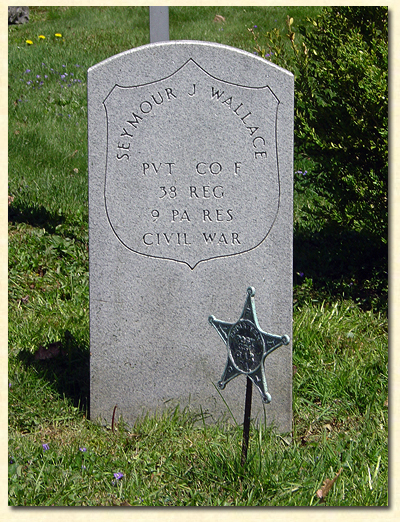
Wallace J. Seymour

Wallace Seymour's grave at Greendale Cemetery, Meadville, Crawford County, PA
While driving through Greendale Cemetery in Meadville, Pennsylvania during May 2007, I spied Wallace Seymour’s headstone. I was looking for a number of graves for members of the 9th Reserves in this medium to large cemetery; however, Seymour’s name was not on my list. Since he was buried close to a convenient intersection, his final resting place was easy to spot and it was a lucky find.

Wallace Seymour was the son of Thomas J. Seymour, a wealthy iron master, and his wife Marian Stowe Barton. From all appearances, Wallace was born in Washington, Clarion County, Pennsylvania. The family settled in Meadville by 1860. When the call for troops was made for the Civil War, the Meadville Volunteers were raised by the local citizenry and were the last company to be accepted into the Pennsylvania State Militia.

Not yet being uniformed or armed, the company was ordered to Pittsburgh for encampment and further orders. Seymour was one of the first men to enlist in the fledgling company that later became identified as Company F. Like Johnson, he was captured at Second Bull Run. Unlike Johnson, his release was not eminent. He rejoined his company at sometime prior to the Battle of Gettysburg. He finished out his tour of duty and was mustered out in Pittsburgh in May 1864.

When the pension laws changed in the late 1870s, Seymour applied for an invalid pension because of a hemorrhage and disease of the lungs that was related to his wartime service. His pension of $24.00 per month was granted in March 1881. Unfortunately, he received only one or two payments as he died one month later on April 17, 1881. His tombstone, which came from Gross Brothers of Lee, Massachusetts, was erected in 1886.

Incidentally, a second tombstone that has his names reversed is found elsewhere in the same cemetery.  Located in the GAR section, this later replacement stone is one of several anomalies that I have found over the years.  

David Aston

David Aston's grave at Old Mt. Pisgah Cemetery, Greetree, Allegheny County, PA
Over the hill from the Mt. Pisgah United Presbyterian Church Cemetery in Greentree, Allegheny County, Pennsylvania is an abandoned cemetery that is overgrown with weeds. Also known as the Mt. Pisgah Cemetery, it is not managed by the church and is the final resting place of five members of the Chartiers Valley Guards, which became Company E of the 9th Pennsylvania Reserves.

Among those in the old cemetery is Corporal David Aston. The fair haired, blue eyed 19 year-old coal miner joined his unit that was an extension of an 1860 Wide Awake club from Temperanceville – now Pittsburgh’s West End. The son of John Aston and Mary Davis, he was born in 1841 at Pontypool, Abergavenny (Upper Division), Trevethan, Monmouthshire, Wales.

When the regiment was organized in June 1861, Aston was elected as the company’s eighth corporal. A year later, he was wounded and captured at White Oak Swamp. By December 8, 1862, he had been released and returned to his unit prior to the Battle of Fredericksburg. He additionally advanced to fourth corporal and finally first corporal in April 1863.

David Aston’s remaining term of service was without incident and he returned home in May 1864. Twenty years to the day after his muster out, David Aston breathed his last on 11 MAY 1884. Gross Brothers also provided this stone which was erected in 1888. Although abandoned as a cemetery, local patriots place flags on the graves every spring. The flag holder was from the Grand Army of the Republic – a post war veterans’ organization. The photo was taken in May 2005 at dusk.

William Minor Croft

William M. Croft's grave at Riverview Cemetery in Parkersburg, Wood County, WV
From Lawrenceville Borough (now in Pittsburgh), William Minor Croft joined Company A (the Pittsburgh Rifles) prior to the Maryland Campaign in September 1862. Croft was born on September 22, 1835 to German immigrants Frederick and Mary Ann Croft. A sawyer by trade, Croft was listed on regimental documents as an experienced carpenter; however, it is not known if these talents were utilized. Since he joined the regiment late, he continued his service in the 190th Pennsylvania Volunteers.

At the Battle of Petersburg in June 1864, Croft was shot in the right wrist. His case was worthy of inclusion in the Surgical & Medical History of the War of the Rebellion, Surgical Volume II. He was operated on by Surgeon J.J. Comfort on July 3, 1864. The surgeon’s report listed that Croft’s “hand [was] turned inward; powerless.” He was discharged on a Surgeon’s Certificate of Disability on 25 February 1865 – it was reported that “his arm is useless” and was considered 2/3 disabled. He was pensioned during the following month.

Croft later relocated to Wood County, West Virginia where he began a lumber concern. He died in 1904 and was buried in Cook-Riverview Cemetery in Parkersburg, West Virginia. One other member of the 9th Reserves, regimental musician Henry Stahl, is buried in this cemetery; in addition, an uncle of two other 9th PRVC vets is also buried there. Over time, Croft’s stone has sunk about an inch. The photo was taken in April 2002.

John Chess

Remnant of John Chess' marker at Union Dale Cemetery, Pittsburgh, PA

Our final shield stone comes from Union Dale Cemetery on Pittsburgh’s North Side and shows only a “nub” of the original marker for John Chess. At the age of 43, Chess was one of the older members of the 9th Pennsylvania Reserves. He and his son, John A. Chess, originally enlisted in the Allegheny Rangers which became Company K. The former Allegheny City tax collector was selected to be the regimental commissary sergeant when the regiment was organized.

There are several references in letters and diaries that debated Sergeant Chess’ culinary abilities. It got so bad that the line officers complained and Chess was reduced to a private and returned to Company K in October 1861. By 1862, he was re-attached to the commissary department with a private’s rank, and he remained in that capacity throughout his service with the Ninth Reserve and his subsequent term as a veteran volunteer with the 190th Pennsylvania Volunteer Infantry. John Chess never was placed in the line of battle during his four year stint with the army - his responsibility was seeing that the “army marched on its stomach.”

His son, who is buried next to him, was mortally wounded at the Battle of Antietam. The elder Chess died in Allegheny City (now Pittsburgh’s North Side) on September 29, 1877. Sheldon and Sons, West Butler, Vermont provided the stone in 1888; however, records indicate that both tombstones were inscribed with the wrong regiment and listed another Pittsburgh area unit: Company D, 123rd Pennsylvania Volunteers. John A. Chess’ stone suffered a similar fate as that of his father’s. This photo was taken in August 2007.

These five examples are representative of one of the styles of government supplied headstones for Union Civil War soldiers. I’ll look at further examples in future installments.

References


Chess, John. Pension record #412.625. Civil War and Later Pension Files; Records of the Department of Veterans Affairs, Record Group 15; National Archives Building, Washington, DC.

Compiled Military Service Records of the 9th Pennsylvania Reserves; Records of the Adjutant General, Record Group 94; National Archives Building, Washington, DC.

Compiled Military Service Records of the 190th Pennsylvania Infantry; Records of the Adjutant General, Record Group 94; National Archives Building, Washington, DC.

Croft, William M. Pension record #575.500. Civil War and Later Pension Files; Records of the Department of Veterans Affairs, Record Group 15; National Archives Building, Washington, DC.

Current Record of Headstones Provided for Deceased Union Civil War Veterans, 1879-1903, Rolls M-1845, National Archives Building, Washington, DC.

Johnson, William. Pension record #515.087. Civil War and Later Pension Files; Records of the Department of Veterans Affairs, Record Group 15; National Archives Building, Washington, DC.

Plat Records of Union Dale Cemetery, Pittsburgh, PA.

Regimental Records of the 9th Pennsylvania Reserves, Civil War Loose Record Files; Records of the Adjutant General, Record Group 94; National Archives Building, Washington, DC.

Regimental Records of the 190th Pennsylvania Infantry, Civil War Loose Record Files; Records of the Adjutant General, Record Group 94; National Archives Building, Washington, DC.

Register for the Central Branch of the National Military Home, Dayton, Ohio; Historical Register of National Homes for Disabled Volunteer Soldiers, 1866-1938; Records of the Department of Veterans Affairs, Record Group 15; National Archives, Washington, D.C.

Seymour, Wallace. Pension record #184,636. Civil War and Later Pension Files; Records of the Department of Veterans Affairs, Record Group 15; National Archives Building, Washington, DC.

Surgical and Medical History of the War of the Rebellion, Surgical Volume II. Washington, DC: Government Printing Office, 1876.

Description of the Masthead Image


The following is a description of the items in the masthead graphic. Caution: Some objects seem more natural than they appear. All relics are related to the 9th Pennsylvania Reserves. Starting at the top and working clockwise.

  • A poster that in essence helped create the New Brighton Rifles (Company H) – a copy appeared in the History of Beaver County.
  • A patriotic cover for the Pennsylvania Volunteers with Colonel Robert Anderson’s signature added to it in Photoshop. Anderson was the original Lt. Colonel and the founding captain of Company D.
  • A photo of General Conrad Feger Jackson that was enhanced by encasing it in a patriotic photo frame. Jackson was the original colonel of the regiment and the founding captain of Company G.
  • Grand Army of the Republic Funeral Mourning Ribbon – fabricated a la Photoshop to be from the Corporal J.E. Turk post from Dayton, PA. Turk was a member of Company F.
  • A real Dranesville Reunion Ribbon for the 9th Reserve and a PA Reserves Ribbon bar. Both from the author’s collection.
  • Company I Captain Hartley Howard’s actual Society of the Fifth Army Corps membership medal. Photographed by the author in 2005.
  • An except from the page of Company C Captain Robert Taggart’s diary where he recounts the horrors he experienced at Antietam.
  • A photo of the Pittsburgh Rifles (Company A) prior to the formation of the regiment. The men are wearing the gray uniforms provided by the citizens of Pittsburgh. Seated (left to right): Hartley Howard, George T. Robinson, and George Dilworth. Standing (left to right): John S. Copley, George J. Hazlett, and Abner U. Howard. The photo is real, but the frame and its glass were created in Crystal Topaz an old DOS based modeling program.

Thursday, May 24, 2012

We Did Genealogy The Old Fashioned Way - We Learned It

If you remember the old Smith Barney commercial featuring the loveable curmudgeon John Houseman, you’ll remember their slogan: “They make money the old fashioned way – they earn it.” Sometimes old ways still can be a valuable training ground for even using new technology.

I find that sometimes when I want to get around problems in Windows, I’ll use the command prompt and type in DOS code and perform functions that would take longer in Windows. The same can be applied with knowing traditional genealogical methods as a base for further research.

One of the problem areas that I find with some of the newer crop of genealogists is that many have only conducted online research and base their conclusions on what can be gleaned via the web. While online records are a Godsend, certain information may only be available in person at a library, archives, court house, or cemetery. While a good number of original documents have been scanned and are currently online, not everything is digitized nor will it be.

In addition, there are numerous errors in the transcriptions of documents. Because of this, sometimes records are missed. I found this to be the case tonight where a record was transcribed based on what the person thought was written in a census record. I frequently see this with my own surname. Ancestry.com has my surname listed as the transcription when a careful read of the name shows that it isn’t Owston, but rather Overton. This is most often misapplication of my surname showing in an index.

To their credit, they have started fixing these errors in the 1930 census where my surname was applied to folks not only with the Overton surname, but others named Austin, Burton, Croxton, Onslow, and Outlaw. One of the worst is a 1940 transcription for a family named Armstrong. How someone could read this listing and get Owston out of it defies any logic that can be mustered.

I imaging that a number of these transcribers have not had adequate experience in reading various handwriting styles. Part of deciphering a difficult name is to compare the letters with others entries made by the original scribe. Unfortunately, not many folks are bothering to do things the “old fashioned way” and “learn it.”

Although these are some of the pitfalls of digitization of handwritten records, all is not bad with moving towards the digitizing of as many records of a genealogical nature. I will admit that a number of my brick walls have been broken down with material found on the numerous pay and free sites I have accessed over the past 16 years. I am grateful for finding the following information online:

  • my second great grandfather’s photo and biographical sketch,
  • an additional marriage for this same second great grandfather,
  • a heretofore unknown half-brother of my grandfather that died at age five,
  • my seventh great grandfather’s ecclesiastical problems with the archdeaconry of the East Riding of Yorkshire,
  • the published works of three of my great-grandfather’s first cousins,
  • the death records and burial locations of numerous relatives,
  • the tragic stories that plagued my mother’s distant cousins,
  • and many more too numerous to mention.

Prior to the proliferation of the Internet, all research was conducted not from the comfort and confines of ones own living room or den, it was done by searching through dusty and yellowed records, recording tombstone inscriptions, and accessing published lists found in old genealogical tomes tucked away in the forgotten library stacks. Census records were often viewed on microfilm readers that were not always illuminated with the best and brightest lamps and were nearly always hand cranked. In some unfortunate occasions, you would discover that someone rewound the film backwards.

While it sounds like I am having a bit of cognitive dissonance, I am not; however, the experience I gained from being onsite to review and search records has been invaluable. As an exercise this past weekend, I started jotting down a list of the locations I have visited firsthand for historical and genealogical research and thought I would share it here. While there are numerous other libraries, archives, cemeteries, and court houses where I received documents via the mail, I have only included those that I have personally visited. They will be enumerated first by type and then by state.

Libraries and Archives

District of Columbia
  • Washington: The Library of Congress
  • Washington: The National Archives and Records Administration
Illinois
  • Chicago Public Library
Kentucky
  • Grayson: Young Library, Kentucky Christian University
  • Louisville Free Public Library
Louisiana
  • New Orleans Public Library
Maryland
  • College Park: National Archives and Records Administration II
  • Hagerstown: Washington County Free Library
Massachusetts
  • Boston Public Library
Michigan
  • Detroit Public Library
New Hampshire
  • Claremont: Fiske Free Library
  • Concord: New Hampshire State Library
Ohio
  • Bettsville Public Library
  • Delaware: Delaware County District Library
  • Tiffen-Seneca Public Library
  • Urbana: Champaign County Public Library
Pennsylvania
  • Bedford: Bedford County Library
  • Bedford: Pioneer Library
  • Carlisle: US Army Military History Institute
  • Connellsville: Carnegie Free Library
  • Franklin Public Library
  • Gettysburg Library
  • Harrisburg: Pennsylvania State Archives
  • Harrisburg: State Library of Pennsylvania
  • McConnellsburg: Fulton County Public Library
  • McKeesport: Carnegie Library of McKeesport
  • McKeesport Heritage Center
  • Meadville: Crawford County Historical Society
  • Oil City Library
  • Pittsburgh: Carnegie Library of Pittsburgh
  • Pittsburgh: Hillman Library, University of Pittsburgh
  • Pittsburgh: Library Resource Facility/Archives Service Center, University of Pittsburgh
  • Pittsburgh: Soldiers and Sailors Memorial Hall & Museum
  • Pittsburgh: Trinity Evangelical Lutheran Church
  • Pittsburgh: Western Pennsylvania Genealogical Society
  • Pittsburgh: Western Pennsylvania Historical Society
Utah
  • Salt Lake City: Family History Library
  • Salt Lake City Public Library
Virginia
  • Blacksburg: Newman Library, Virginia Polytechnic University and State University
  • Harrisonburg: Carrier Library, James Madison University
  • Richmond National Battlefield Park
West Virginia
  • Athens: Concord University Library
  • Barboursville: Family History Library
  • Beckley: Raleigh County Memorial Library
  • Beckley: Robert C. Byrd Learning Resource Center, Mountain State University
  • Bethany: T.W. Phillips Memorial Library, Bethany College
  • Charleston: Archives and History Library, The Cultural Center
  • Charleston: Kanawha County Public Library
  • Charleston: US District Court
  • Huntington: Cabell County Public Library
  • Huntington: James E. Morrow Library, Marshall University
  • Huntington: John Deaver Drinko Library, Marshall University
  • Institute: Drain-Jordan Library, West Virginia State University
  • Morgantown: West Virginia & Regional History Collection, West Virginia University
  • Oak Hill Public Library
  • Parkersburg & Wood County Public Library
  • Point Pleasant: Mason County Public Library
  • Salem: Benedum Resource Learning Center, Salem International University
  • Sissonville: Family History Library
  • South Charleston: Marshall University Graduate College Library

Court Houses and Town Repositories

Maryland
  • Washington County
Michigan
  • Wayne County
New Hampshire
  • City of Claremont
New Jersey
  • Essex County
Ohio
  • Belmont County
  • Champaign County
  • Delaware County
  • Seneca County
Pennsylvania
  • Allegheny County
  • Bedford County
  • Franklin County
  • Fulton County
  • Venango County
Vermont
  • Town of Weathersfield
West Virginia
  • Kanawha County
  • Logan County
  • Raleigh County

Cemeteries by Location

(These are only listed by town. In many cases, there are multiple cemeteries for each location – for example, there were probably 20 cemeteries accessed for Pittsburgh alone.)

Connecticut
  • Norwich, New London County
Illinois
  • Chicago, Cook County
Kentucky
  • Grayson, Carter County
Louisiana
  • Abita Springs, St. Tammany Parish
  • New Orleans, Orleans Parish
Maryland
  • Hancock, Washington County
Missouri
  • Kansas City, Jackson County
New Hampshire
  • Claremont, Sullivan County
New Jersey
  • East Orange, Essex County
Ohio
  • Barberton, Summit County
  • Butler, Richland County
  • Canton, Stark County
  • Dayton, Montgomery County
  • Delaware, Delaware County
  • Fostoria, Seneca County
  • Norton, Summit County
Ancestral Location of my Mother's family
 Pennsylvania
  • Bethel Township, Fulton County
  • Brackenridge, Allegheny County
  • Bridgeville, Allegheny County
  • Carrick, Allegheny County
  • Connellsville, Fayette County
  • Coraopolis, Allegheny County
  • Crafton, Allegheny County
  • Dayton, Armstrong County
  • Delmont, Westmoreland County
  • Dravosburg, Allegheny County
  • Elizabeth Borough, Allegheny County
  • Elizabeth Township, Allegheny County
  • Forward Township, Allegheny County
  • Homestead, Allegheny County
  • Hopwood, Fayette County
  • Irwin, Westmoreland County
  • Johnstown, Cambra County
  • Lodi, Butler County
  • Madley, Bedford County
  • McKeesport, Allegheny County
  • Meadville, Crawford County
  • Monongahela, Washington County
  • Munhall, Allegheny County
  • Natrona Heights, Allegheny County
  • New Brighton, Beaver County
  • North Braddock, Allegheny County
  • North Huntingdon, Westmoreland County
  • North Versailles, Allegheny County
  • Oil City, Venango County
  • Penn Hills, Allegheny County
  • Pleasant Hills, Allegheny County
  • Plum Boro, Allegheny County
  • Pittsburgh, Allegheny County
  • Reserve Township, Allegheny County
  • Saltsburg, Indiana County
  • Sewickley, Allegheny County
  • Smicksburg, Indiana County
  • Thompson Township, Fulton County
  • Washington, Washington County
  • West Elizabeth, Allegheny County
  • White Oak, Allegheny County
  • Wilkinsburg, Allegheny County
West Virginia
  • Beckley, Raleigh County
  • Berkeley Springs, Morgan County
  • Bethany, Brooke County
  • Elkview, Kanawha County
  • Fayetteville, Fayette County
  • Grantsville, Calhoun County
  • Hometown, Putnam County
  • Leon, Mason County
  • Lewisburg, Greenbrier County
  • Manila, Boone County
  • Parkersburg, Wood County
  • Pecks Mill, Logan County
  • Princeton, Mercer County
Virginia
  • Arlington, Arlington County
  • Charlottesville (independent city)
  • Culpeper, Culpeper County
  • Fredericksburg (independent city)
I am amazed at the sheer number of locations I’ve visited since 1978 and am glad that much of this was accomplished when gasoline was less expensive. For some sites, I’ve only visited once, such as the Detroit and Chicago public libraries. The three most frequented locations include the National Archives’ main location at least 25 times, the Cultural Center in Charleston, WV (about 30 times) and the Carnegie Library of Pittsburgh in the neighborhood of 100 times.

Much of my research centered on families from Western Pennsylvania; however, this library’s Pennsylvania Department has excellent materials from outside the region it serves. It is also the repository for the records of the Western Pennsylvania Genealogical Society and holds the microfiche for all of birth and death records for Allegheny County prior to 1906. It is also the first library I visited in searching my own family’s roots in 1978. It was here that I learned first hand from the librarians how to conduct genealogical research and what records were the best to consult.

Only by searching onsite was I able to find information on children that were not recorded elsewhere as well as other golden nuggets of information. It is how I discovered the actual identity of my great grandmother as our family had recorded her name incorrectly and she was my most recent brick wall. When her name was correctly ascertained, it opened up a world of colonial New England ancestors including four patriots. That trip to the National Archives was one of my most productive.

Today if a road trip is planned, I utilize what information I can find online to maximize the trip to its potential. I determine what may or may not be available. If looking for old newspapers for obituaries, I have the dates in advance. Most times, I always find something on the individuals for whom I am searching. Good luck and good hunting in the vast genealogical wasteland away from Internet civilization.

Sunday, May 13, 2012

Stanley Sudeikis Was Not A Bigamist


NOTE:  See the comments at the end of this post, as Peter Bush appears to have uncovered the connection to Bridgeport, CT that was not adequately explained in the Sudeikis episode.  Unfortunately, the two listings in the 1930 census are still somewhat problematic and still may indicate two distinct individuals with the same name.

Although I have a reasonable doubt regarding my original premise, I will allow the post to stand.  It and John Lisle's and Peter Bush's additional information in the comment section will serve as a reminder that genealogical research often requires a deeper analysis to reach conclusions. It is more difficult than taking one or two records that appear to point to a conclusion at face value.  While the necessary "due diligence" probably occurred, it was not portrayed as such in the show's final edit. This show appeared to be based on conjecture rather than strong research - which is why I had my doubts.

A good genealogist will question the evidence, search for additional resources, and weigh everything in an effort to find the truth.  While this may have occurred in the research phase of this episode, it was not fully articulated - hence why several of us questioned the results and the methods utilized.  Thanks to Peter Bush and John Lisle for their tireless efforts in pursuing additional resources, we now can see a connection that seemed improbable; however, that still does not resolve the larger issues discussed below. Additional research may need to be conducted for a complete resolution of all remaining doubts in this particular episode. 

Jim Owston, May 21, 2012

The original post follows . . . 

Stanley Sudeikis, Sr. was not a bigamist. Well, that’s pretty direct statement, but who is Stanley Sudeikis and why should we even care? If you tuned into NBC’s “Who Do You Think You Are” this past Friday night, you were treated with a fascinating story of Jason Sudeikis’ paternal history.

His questions regarding his grandfather were answered. He found out that his grandparents were legally separated and that his grandfather had refused to work and died by fracturing his skull on the steps of a church at the corner of 50th and Honore in Chicago. It is supposed that he was intoxicated at the time. He also found out that his grandfather had never even seen his dad – not even once.

In tracing this line backwards, they found Stanley’s parents Stanley Sudeikis and Michalina (Emma) Bielska. They searched Ancestry.com for Stanley in the 1920 census and lo and behold, it appeared that he had two families – one in Chicago and one in Bridgeport, CT.

The show suggested that Stanley Sudeikis might have been a bigamist having abandoned his first family and having started another in 1918. Much of this theory was built upon Stanley being missing in the 1920 census for Chicago, but a Stanley Sedakis was listed with another family in Bridgeport. To the show’s credit, the premise of bigamy was presented but was never conclusively stated as the case; however, this hypothesis becomes part of the episode’s overall theme.


Next, Jason traced Stanley to a ship’s manifest from August 1900 that points to Stanley being a son of Joseph Sudeikis – a coal miner in the anthracite region of Pennsylvania. Joseph Sudeikis tragically died in a mine explosion in November 1900. Thus, Jason’s family began a trend of children without fathers. Starting with the death of Joseph, it continued with the abandonment of Stanley, Sr.’s family in Chicago and Stanley, Jr.’s lack of responsibility towards his wife and children. Or did it?

Had the genealogists involved conducted a little extra research, their hypothesis that Stanley Sudeikis, Sr. was not responsible for his family and was possibly a bigamist would have been rejected. Although a great story, two genealogical errors occurred during the research for this episode.

Error One: If the name is the same, then it is the same person. This occurred with the assumption that Stanley in Chicago was one and the same as Stanley in Bridgeport.

You find this error occurring frequently among genealogies involving low frequency surnames. The rarer the surname – we might be more likely to apply the “name is the same – same person” conclusion. The temptation is greater to conclude that Stanley Sudeikis #1 and Stanley Sudeikis #2 were one the same than it would be to deduce that John Smith #1 is the same as John Smith #2. This is a fairly common genealogical error that has created misinformation in published genealogies and hundreds of family trees posted on Ancestry.com.

Recently while studying several SAR and DAR applications for my family, I found the military service of one man being ascribed to a different man of the same name (cousins) from the same geographic area. This occurred in six DAR applications; however, the lone SAR application had the service correct. In applications for another patriot, I found two DAR applications and two SAR applications that appended the service of one patriot to that of another with the same name. In the case of the DAR applications, the national organization caught the mistake.

Error Two: Using a minimal number of sources to prove a theory without triangulating the data with other available sources. In an era where records were infrequently kept and only one source is available, this can be an acceptable tactic to form a hypothesis; however, where other sources can prove or disprove a theory are not employed, it is sloppy research.

Both of these errors create a slippery slope in a family tree that will deviate from a true lineage. These errors are usually committed by neophytes. I cannot understand why the genealogists involved in this episode did not probe deeper. Maybe they did and the truth was not as a compelling story as that was presented on the show.

If this were the case, the producers decided to go with the story rather than the facts. Hmmm, it does sound a great deal like current Hollywood practices when dealing with historical events. Just last night I saw a TV show with a Civil War officer. His rank was that of a colonel, but he was wearing the frock coat of a general officer and the shoulder boards of a second lieutenant. I know, this sounds a bit anal retentive, but I can’t help it – a lack of accuracy bugs me.

Stanley in Chicago ≠ Stanley in Bridgeport


Midway through the episode, Jason Sudeikis meets with Chicago area genealogist Hilary Mac Austin at the Newberry Library. Together they discovered while searching the 1920 census that Stanley is absent from the household with his wife and Stanley, Jr.


They returned to the 1920 census to determine his whereabouts, and in the process, they found a Stanley Sedakis with another family living in Bridgeport, Connecticut. The discourse was as follows:

Sudeikis: “Well then, so he had two families?”

Austin: “It looks like he might have. I mean It’s not as though there are that many Stanley Sudeikises listed . . . and [pointing to his birth place] it’s Lithuania.”

Having ancestors that frequently relocated, I can appreciate families moving great distances. For example, my own great-grandfather lived in six states and one Canadian province during his 74 years. Even with that in my own background, the unprecedented jump from Chicago to Bridgeport was quite a stretch – not impossible, but that is where my doubts began to surface. Let’s look at the records and see where they deviate from each other.

According to the ship’s manifest and the 1910 census, Stanley, Sr. emigrated from Lithuania in 1900. Some records will have Russia – don’t let that throw you, as the current country name is used in the census and as borders change sometimes the designation in the census will change as well. For the greatest portion of Lithuania during the last several centuries, it was under Russian or Soviet control.

The show used information from his marriage record and the 1920 and 1930 Connecticut census records to construct a picture of the Bridgeport Stanley. So far so good; however, there are three things to remember when dealing with census records.

  • The data is as only good as the person supplying the information. That individual may have been misinformed, mistaken, or simply guessing. The informant may have known the correct data at one time, but had forgotten the details.

  • The census taker may have made mistakes while transcribing the information.

  • The person in question may be lying.

Because of the above, census records may deviate on details from record to record. So the exact answer may be convoluted because of conflicting data. In my cursory search of this family line, I discovered that some details varied from census to census. The ages varied and the year of immigration also varied.

In addition, a person missing from the household, as with the Chicago Sudeikis family, does not mean that individual was gone on a permanent basis or that he had abandoned his family. It meant that subject was not living in the household on April 1. The missing individual could have been temporarily working in another town, been incarcerated, or had been a resident of an infirmary on April 1.

That individual may have been back in the home when the census was actually taken; however, the information is based on whether that individual was there on April 1. Stanley, Sr.’s absence is not conclusive that he was one and the same as the Bridgeport Stanley – which is where this identity crisis began.

While they used the 1930 census to build information regarding the Bridgeport Stanley, they failed to check the Chicago census for the same year. Upon examination, Stanley, Emma, and Stanley, Jr. are all present within the same household in 1930.

Click image for the full census page.

Looking at other data from Ancestry, a picture develops of Stanley, Sr. of Chicago that may explain why he was missing. While not conclusive of being the same person, a World War I draft registration card for a Stanley Sudikis from 1917 has his residence as being Kenosha, Wisconsin. Kenosha is 62 miles to the north of Chicago. The card lists this Stanley as having a wife and a child – the same family arrangement as the Chicago Stanley. His date of birth is listed as July 10, 1890.

In addition, a daughter was born to the Chicago Stanley in 1921. Michalina Sudeikis was born on 20 January 1921 to Stanley Sudeikis and Michalina Bielska. Stanley is aged 28 on the record placing his year of birth at 1893. It appears that this daughter did not survive childhood as she is missing from the 1930 census. If Stanley is the father (as stated on the document) and the birth happened at term, then conception would have occurred in late April 1920.

Click document for a larger version.

I’ve also found three additional men named Stanley Sudeikis – one born in Chicago in 1913 and who settled in Kalamazoo, Michigan; a 35 year old Stanislaw Sudeikis who immigrated to Chicago in 1907; and one who was born in 1907 and immigrated the same year – he was a resident of Chester, Delaware in 1930 – his mother’s name was Mary as well.

In the 20 August 1914 marriage records of Holy Cross Church in Chicago for Joseph and Michalinam Bielskis, it lists Stanley’s parents as Joseph and Mariamnae Gecaite. In addition, no divorce record was found for Stanley and Emma Sudeikis. Emma’s 1947 death record lists her husband as Stanley; however, this is not conclusive whether he was still living or still living with her.


In his trip to Bridgeport, Jason found the 28 August 1918 marriage record of Stanley and Amelia Trakaitis. Stanley’s parents were listed as Joseph and Mary Gash. Genealogist Dr. Bob Rafford suggested that Gash may be an anglicized name for Gecaite. Hmmm. I guess that is possible, but the other names on the document are not Anglicized – so why should this one name be different?

While the parental names are similar, I think the evidence of the Stanley in Chicago fathering a child in 1921 and being present in the 1930 census in Chicago is enough to suspend the idea that the Bridgeport and Chicago Stanleys were one and the same. Since both men have a 1930 census record, it is not very probable that the two men were the same individual. In other words, how can a person be in two places at the same time? While I have seen some individuals listed twice in the same census (my second great grandmother for one), this is an exception to the rule (and the ones I have encountered were in the same geographic region). 

In addition, Stanley and Emma are missing from the extant Chicago city directories on Fold3; however, Stanley and Amelia/Millie (as she is recorded both ways) are found in the 1927 to 1931 Bridgeport directories on Ancestry.com. Amelia is listed as Stanley’s widow in the 1935 directory; however, the 1932-1934 directories were not available.

Why Bridgeport?


As I said at the outset, it is a stretch for an unskilled laborer working in Chicago to seek work in Connecticut. Chicago ranked as the second largest populated US metropolitan area in 1920; Bridgeport, in comparison, ranked 44th. While Bridgeport is a large city, employment opportunities in Chicago and the surrounding region would have been much better.

The Chicago Stanley had no known connection to Bridgeport. According to the census records, neither Stanley served in the military. If they had, Bridgeport’s Naval Base could be a connection to the city; however, this is not the case. It appears that Ameilia Trakaitis arrived in New York from Lithuania on 12 October 1913. Since Stanley, Sr. left Lithuania at approximately the age of eight, it does not appear that he would have had prior knowledge of Amelia.


In 1920, three rail lines offered service from New York to Chicago. The New York Central ran a northerly route to Albany, Buffalo, Cleveland, Toledo, and on to Chicago. The most southerly route was via the Pennsylvania Rail Road to Philadelphia, Pittsburgh, Ft. Wayne, and then to Chicago. The Erie Rail Road had the most direct route. The Erie Limited line traveled to Binghampton, NY; Marion, Ohio; and then Chicago.

Considering that both Stanleys in the 1920s era were laborers and the great distance involved in pre-air travel, it would be difficult and cost prohibitive for a man to continue the ruse of having two separate families at a distance of 850 miles. Even though the Bridgeport Stanley was financially stable in 1930, it is still quite a stretch. Had the second family been in Kenosha, Wisconsin; Joliet, Illinois; or Gary, Indiana; then the probability would have been much greater that the two men were one and the same.

My ruling – the men were two different individuals and Stanley Sudeikis, Sr. of Chicago was not a bigamist. Just to be safe, perhaps, I should rephrase that to “the evidence does not indicate that Stanley Sudeikis was a bigamist.” I will say that all information was accessed via Ancestry.com and its Fold3 subsidiary; no researchers were harmed in the gathering of this data.

The complete episode can be found below.


I also take issue with the coal miner angle, which may or may not be correct. Information in the 1900 and 1910 census for Mahanoy City, Pennsylvania creates a bit of doubt in my mind. Their case was much stronger regarding this relationship, so I will refrain from discussing it, as further evidence (not currently residing on Ancestry.com) is necessary to conclusively decide one way or the other.

Addendum: added on 5/14/2012


One of the readers of this post felt the strength of the confirmation that the two Stanleys were one and the same is based on similar signatures. The signatures were addressed for a period of only 23 seconds, and it was a very minor portion of the show. The discourse was as follows:

Sudeikis: “The ‘T’ into ‘A’ to ‘N’ – very, very similar.”

Rafford: “I think there is enough similarity between these two signatures to think that these are one and the same men [sic].”

To my knowledge, Sudeikis and Rafford are not handwriting experts, and neither am I. This is why I didn’t deal with it in my original post. From a evidential aspect, it is the weakest link suggested in the show. I am providing both signatures below. There are enough differences between the two signatures to indicate that different men signed these documents.
 

Since signatures will vary over time, I decided to find  a comparison with the signatures from the same person. Since I had already scanned a number of my father’s documents, I used him as the control signature with three iterations. The first came from 1936 and was from his car registration; the second, his selective service card from 1945; and the third was his lodge membership card from 1957.


Signed with a fountain pen, the earliest signature had more variations from the other two which utilized a ball point pen. It is pretty obvious these three signatures over a 21 year period were made by the same person. The continuation of the end of the “N” that crossed the “T” is a dead giveaway; however, the direction is backwards in the 1936 version. The two Stanley Sudeikis signatures only four years distant do not share as many similarities as the signatures of my father.

You be the judge.


Addendum: added on 5/22/2012

Peter Bush, who has been commenting on this post, made reference to his wife discovering that Stanley Sudeikis, Sr. was living at the same address in the 1910 census as he did for his marriage in 1914.  Peter also listed below (in the comment section) the addresses his wife found for Stanley, Sr.'s niece - Ann(a) Pukel(is).

I did the same for Stanley, Sr.'s family.  From 1910 to 1930 the family lived within an area of  24 city blocks.  Stanley, Jr. also died within this section of town.  Using Google Maps, I constructed the following map of the area.


A. 1910-1914; 4515 South Wood Street.
B. 1915; 4608 South Wood Street.
C. 1920; 1733 W. 51st Street, Rear.
D. 1921; 4730 South Hermitage.
E. 1930; 1920 W. 47th Street, Apartment 3.
F. 1947; W. 50th Street & South Honore Street (where Stanley, Jr. died).

I checked twenty-one 1940 census enumeration districts surrounding this area, but was unable to find the Sudeikis family.  It is possible that I missed their entry in this exercise.  Once the 1940 index for Illinois is complete, we may be able to find this particular family.